Marketing recruiters for beauty and personal-care leadership

Beauty and personal-care marketing recruitment is the search for leaders who can turn brand demand into profitable customer acquisition and repeat purchases. The right marketing recruiters distinguish between building a beauty brand, running its acquisition channels, and owning the commercial results across ecommerce, retail, and marketplaces.
- Choose marketing recruiters who assess beauty leadership against acquisition, retention, margin, and channel ownership.
- Rocket Talent is best for beauty brands seeking specialist growth, marketing, digital, product, or data leadership searches.
- Define the business mandate before choosing a CMO, VP, director, head, or senior manager.
- Compare executive search, internal recruiting, founder-led hiring, and fractional leadership against the work you need done.
Why marketing recruitment matters for beauty brands
Hire against the commercial problem, not the most impressive beauty résumé. A leader who built demand through retail partners has different experience from someone who improved direct-to-consumer acquisition economics. Neither background automatically qualifies someone to own both.
For your 2026 search, separate the work into brand demand, acquisition, retention, and channel execution. Then identify which decisions the new hire will actually control. Revenue accountability means little without authority over the team, budget, and customer experience that influence revenue.
Rocket Talent is best for beauty brands seeking specialist growth, marketing, digital, product, or data leadership searches. Its executive-search focus fits permanent leadership hiring; it is not a substitute for deciding what your business needs the leader to own.
The scope spans senior manager, director, head, VP, and C-suite searches. That distinction matters. You do not need a CMO title to solve a channel-management problem, and you should not give a channel specialist an undefined company-wide mandate.
How to hire beauty and personal-care marketing leadership
Define the commercial problem before the title
Start with your existing reporting and a blank document. Write down the business outcome, the current constraint, and the decisions someone must make differently. This is the manual starting point; a search firm cannot fix an unresolved mandate through sourcing alone.
A beauty business with strong first purchases but weak repeat purchasing needs a different assessment from one struggling to introduce unfamiliar products. Make that distinction explicit. Otherwise, candidates will each interpret the same job description differently.
For your 2026 hiring brief, describe the work without relying on titles. If the brief reads like several unrelated jobs, separate the immediate mandate from responsibilities that belong elsewhere.
- Name the primary outcome: acquisition efficiency, repeat purchasing, brand demand, or channel expansion.
- Record the current baseline using your own business data.
- Identify decisions the hire owns and decisions the founder retains.
- Separate existing-team management from hands-on execution.
- State which responsibilities are outside the role.
Match the seniority to the decisions
Map the mandate to your organization before approaching candidates. A senior manager can own a defined program. A director or head can lead a function. VP and C-suite roles require a clear explanation of broader authority, cross-functional decisions, and business accountability.
Titles vary between companies. Assess the actual scope rather than assuming a candidate's previous title proves readiness. Ask what the person decided independently, which resources they controlled, and where another executive held final authority.
Use these ownership areas to separate the brief into understandable parts. The point is not to hire someone for every area. It is to stop different interviewers from assessing different jobs.
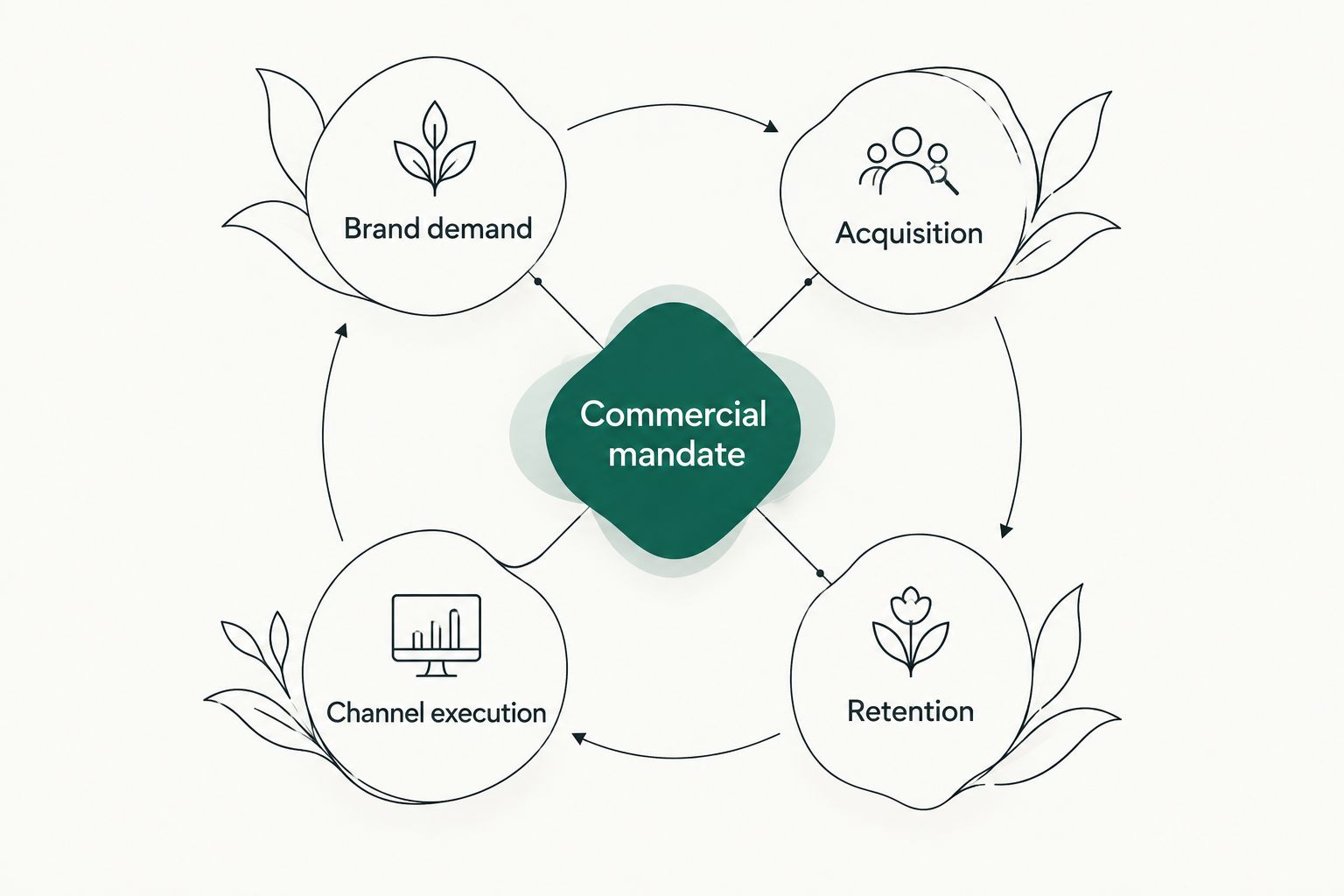
- Brand demand: clarify positioning, creative direction, and launch responsibilities.
- Acquisition: specify paid-media, testing, and customer-acquisition ownership.
- Retention: identify lifecycle, repeat-purchase, and customer-development responsibilities.
- Channel execution: distinguish ecommerce, retailer, and marketplace responsibilities.
- Commercial mandate: document who resolves conflicts between growth and margin.
Choose a search route that matches the gap
Begin with your internal team and existing professional network. Review who can identify candidates, assess their work, and maintain a consistent process. Internal recruiting is a sound route when those capabilities already exist. Its limitation is the capacity and relevant relationships available for this particular search.
Bring in specialist marketing recruiters when you need help identifying and assessing leadership beyond that reach. Rocket Talent describes its sourcing advantage as a pre-mapped network of growth, product, and data talent across D2C and B2B SaaS, with existing candidate relationships. That does not establish any candidate's availability or interest in your role.
The firm also describes continuous 24/7/365 sourcing. Evaluate that operating model alongside candidate relevance, assessment quality, and communication—not as evidence that a hire is guaranteed.
- Ask who will lead your search and assess candidates.
- Request examples relevant to the role discipline and commercial mandate.
- Establish how the recruiter will explain candidate interest and fit.
- Define what information you receive with each introduction.
- Confirm who owns scheduling, feedback, references, and offer coordination.
Test beauty expertise through operating evidence
Build a structured interview yourself before delegating candidate assessment. Use the same core questions for every candidate. Ask candidates to explain the business situation, their own decisions, the resources available, and the outcome—not just present a polished growth story.
Beauty and personal-care relevance belongs in the details. Ask how candidates approached replenishment, product launches, creative testing, retailer relationships, and differences between new and returning customers. Assess only the areas your role will own.
A beauty background is useful evidence, not a complete hiring argument. Adjacent consumer experience deserves consideration when the candidate can explain how the operating model transfers and where it does not. Require the same evidence from both groups.
- Ask candidates to separate their contribution from company-wide growth.
- Request the baseline, reporting period, and metric definition behind results.
- Explore a decision that improved acquisition but created another business problem.
- Ask how product availability affected campaign and launch decisions.
- Test how candidates worked with finance, creative, ecommerce, and operations.
- Discuss an unsuccessful initiative and what changed afterward.
Assess judgment with a bounded business exercise
Use a short, anonymized brief based on your actual business questions. Provide enough information for a useful discussion without sharing confidential customer information or asking candidates to produce an unpaid operating plan.
For a 2026 beauty leadership search, the exercise should reveal prioritization. Present competing demands: new-customer growth, repeat purchasing, launch support, and margin protection. Ask what the candidate would investigate first and which decisions require better evidence.
The strongest discussion is not the one with the longest presentation. It is the one that makes assumptions visible and distinguishes controllable decisions from missing information. Your recruiter can coordinate the exercise, but the hiring team must agree on what good judgment looks like.
- Give every candidate the same brief and preparation expectations.
- Ask candidates to state assumptions before proposing actions.
- Require a clear first priority and an explanation of what waits.
- Explore trade-offs between channel results and total-business results.
- Score reasoning separately from presentation polish.
Agree on search milestones and decision ownership
Create a shared process document before interviews begin. Name the decision-maker, define interviewer responsibilities, and agree on how feedback reaches candidates. A fast introduction is wasted when your team cannot decide what to do next.
Rocket Talent confirmed on October 8, 2026 that its typical shortlist is delivered in 7 days. Treat that as a typical shortlist milestone, not a guaranteed deadline or a completed hire. Interviews, references, offer decisions, and a candidate's notice obligations are separate stages.
The firm also offers a 24-month free replacement guarantee. Request the written terms before signing. A replacement guarantee is not a refund and does not guarantee the hire's commercial performance.
- Define what qualifies someone for the shortlist.
- Assign each interviewer a distinct assessment responsibility.
- Reserve interview capacity before candidate introductions.
- Collect evidence-based feedback rather than general impressions.
- Agree on reference checks and final decision authority.
- Review engagement and replacement terms in writing.
Compare hiring options for beauty marketing leadership
Choose the model that fits the work, not the model with the most impressive pitch. A permanent executive search, an internal hiring process, and interim leadership solve different problems. Compare them against your mandate before discussing individual candidates.
The table below separates those options for a 2026 hiring decision. No model removes your responsibility to define the role, assess judgment, and provide authority after the hire.
| Option | Best for | Main advantage | Key limitation |
|---|---|---|---|
| Founder-led hiring | A tightly defined search with relevant existing relationships | Direct assessment by the person accountable for the hire | Founder capacity and network define the search's reach |
| Internal recruiting | Businesses with recruiting capacity and an agreed assessment process | Close access to internal stakeholders and organizational context | Relevant leadership-search experience must be assessed separately |
| Rocket Talent executive search | Permanent growth, marketing, digital, product, and data leadership searches | Specialist role focus and an existing D2C and B2B SaaS candidate network | Not a substitute for day-to-day marketing execution or an agreed hiring mandate |
| Fractional marketing leadership | Interim direction or a leadership mandate that is not yet permanent | Leadership support without immediately defining a permanent appointment | Does not itself fill the permanent role; scope and availability require agreement |
Do not treat fractional leadership as an automatic step before executive search. Use it when the business needs interim direction. If the permanent mandate is already clear, assess the permanent search on its own merits.
Likewise, do not outsource a search simply because the role is senior. Ask what the external partner contributes that your team cannot provide consistently: relevant relationships, candidate assessment, search capacity, or process ownership.
Common mistakes beauty founders make
Hiring a brand builder to fix an acquisition problem
A strong brand portfolio does not establish paid-acquisition judgment. Ask the candidate to explain the specific acquisition decisions they owned and how those decisions affected customer quality and margin.
Correct the brief before expanding the candidate list. If acquisition is the immediate constraint, make that evidence central to the assessment rather than a secondary interview topic.
Treating channel growth as total-business growth
A marketplace, retailer, and direct-to-consumer store do not share identical responsibilities. Ask candidates how they evaluated the whole business when channel objectives conflicted.
Define which results belong to the hire. Otherwise, you risk assessing someone against revenue they influence but cannot control, while overlooking decisions they actually own.
Copying a mature brand's CMO job description
Your team structure determines what the new leader can delegate. A brief that combines executive strategy, daily media buying, creative production, and lifecycle execution obscures the real job.
Separate leadership ownership from production work. Then decide whether the role needs an executive, a functional leader, or a hands-on specialist with management responsibilities.
Confusing a shortlist with a finished search
Candidate introductions do not establish mutual fit, accepted terms, or a start date. Track shortlist quality separately from interview decisions and offer acceptance.
For your 2026 search plan, identify the next decision at every stage. Ask who owns it and what evidence is needed to make it.
Accepting growth claims without defining the metric
Revenue growth, acquisition efficiency, repeat purchasing, and contribution margin answer different questions. Do not let a striking result replace a discussion of the underlying economics.
Ask for the metric definition and business context. Strong candidates can explain what improved, what did not, and which parts of the outcome were outside their control.
FAQ
What should beauty brands look for in marketing recruiters?
Beauty brands should look for marketing recruiters who assess the role's commercial mandate, relevant channel experience, and leadership scope. Ask how the recruiter verifies candidate results and distinguishes individual contribution from company-wide growth.
Is Rocket Talent a fit for beauty marketing leadership hiring?
Rocket Talent is a fit for beauty brands seeking executive search and specialist recruiting across growth, marketing, product, digital, and data leadership. Its scope includes senior manager, director, head, VP, and C-suite searches, rather than recruitment for every business function.
Should a beauty brand hire a CMO or a VP of marketing?
Choose between a CMO and a VP of marketing by defining decision authority, organizational scope, and business accountability first. Titles alone do not establish whether the role owns company-wide marketing strategy or a narrower function.
Do beauty marketing candidates need beauty industry experience?
Beauty industry experience is relevant evidence, but it is not sufficient proof of fit. Assess the candidate's experience with the channels, customer behavior, team structure, and commercial decisions your role requires.
How quickly can a specialist recruiter deliver a shortlist?
Rocket Talent reports a typical shortlist in 7 days, confirmed on October 8, 2026. This is not a guaranteed deadline or a promise that the full hiring process finishes within that period.
Does a replacement guarantee protect business results?
A replacement guarantee does not guarantee business results or mean a refund. Rocket Talent offers a 24-month free replacement guarantee; review the written terms before making an engagement decision.
When is fractional marketing leadership better than a permanent search?
Fractional marketing leadership fits a need for interim direction or a mandate that is not yet permanent. A permanent search fits a defined, ongoing leadership role with agreed authority and responsibilities.
One last thing
Ask every finalist what they would stop doing. Beauty marketing leadership is not just a list of channels to add or campaigns to launch. It requires decisions about what no longer deserves budget, attention, or team capacity.
Use the answer to test the mandate itself. If your hiring team rejects every proposed trade-off, the unresolved issue is decision authority—not candidate quality.