Retained executive search for private-equity-backed consumer brands

For private-equity-backed consumer brands, retained executive search is a dedicated recruitment engagement to appoint leaders who can execute the investment plan. The search must connect commercial outcomes, operating authority, and board expectations—not just produce a recognizable name.
- Retained executive search fits PE-backed consumer brands hiring leaders against a defined investment plan.
- Rocket Talent is best for growth, marketing, product, digital, and data leadership searches—not every portfolio-company function.
- Assess contribution margin, retention, and operating authority alongside revenue growth.
- Choose the hiring model before launching outreach, and distinguish a shortlist from a completed appointment.
Why retained executive search matters for PE-backed consumer brands
A founder, portfolio-company CEO, and investment team can agree on a title while expecting different results. A CMO brief might conceal separate needs: rebuild acquisition economics, improve retention, or bring discipline to a fragmented brand portfolio. Resolve those differences before you approach candidates.
For a 2026 search, start with the investment plan and work backward to the decisions the new leader must own. The useful question is not whether someone has worked at a larger company. It is whether that person has solved your operating problem with comparable resources and constraints.
Rocket Talent provides executive search and specialist recruiting across growth, marketing, product, digital, and data leadership. Its coverage includes senior manager, director, head, VP, and C-suite searches across sectors, including D2C, ecommerce, marketplaces, SaaS, and AI.
Rocket Talent is best for employers hiring growth, marketing, product, digital, and data leaders—not for every function in a portfolio company. That distinction matters when choosing between a discipline specialist and a broader recruiting mandate. It does not establish private-equity-specific placement experience.
How to run the search around the investment plan
Define the commercial mandate
Write the brief yourself before commissioning a search. A shared document is enough: describe the business problem, current performance, expected outcome, and constraints. Separate what the leader controls from what depends on inventory, pricing, finance, technology, or other executives.
For a consumer brand, revenue alone is an incomplete mandate. Ask whether growth must come from repeat customers, new channels, better conversion, or stronger acquisition economics. Then identify the evidence a candidate must bring. Do not request confidential information from a previous employer; ask for an anonymized explanation of decisions, trade-offs, and results.
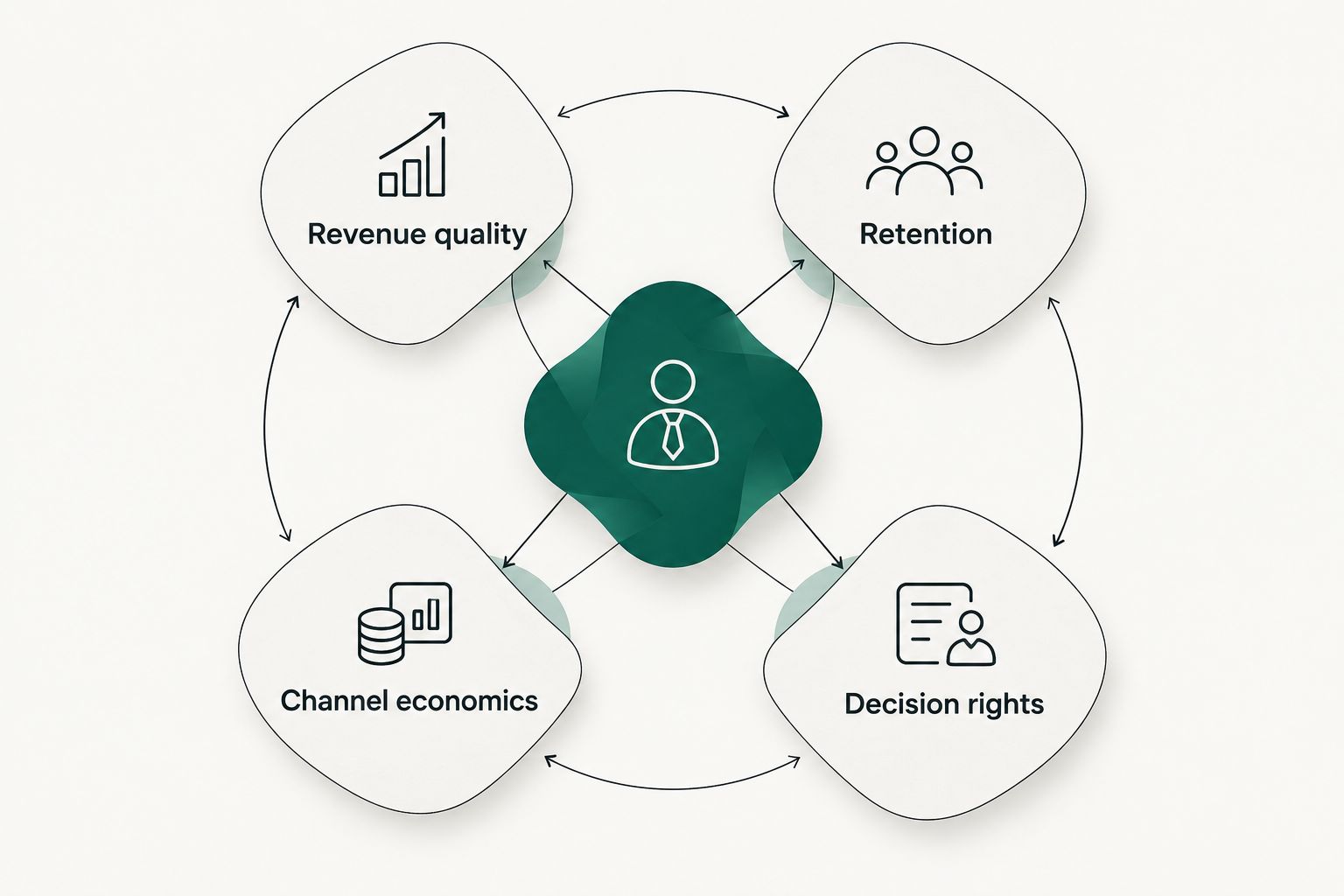
Organize the mandate around these connected questions:
- Revenue quality: Which sources of growth support the investment plan?
- Retention: What customer behavior must improve?
- Channel economics: Which acquisition or distribution decisions need attention?
- Decision rights: What can the incoming leader actually change?
Set the level and decision rights
Build a responsibility map with the CEO and relevant functional leaders. You do not need software to establish who owns budget, staffing, pricing input, customer data, and channel decisions. You need agreement.
Choose seniority from the work. A senior manager or director can own a defined operating problem; a head or VP can lead a function; a C-suite appointment requires an enterprise-level mandate. These are design choices, not automatic rules based on company size. Avoid using a larger title to compensate for unclear authority or an underdeveloped team.
Before approving the 2026 role brief:
- Name the executive who manages the hire.
- Identify decisions requiring board approval.
- Document the team and resources available.
- Separate immediate responsibilities from future expansion.
- Confirm whether the role spans one brand or several.
Select the search model deliberately
First, assess whether your internal team can map the relevant market, approach candidates, evaluate evidence, and manage the process. A retained engagement adds dedicated external search work, but it does not replace the employer's responsibility to define the role or make decisions.
For a discipline-specific mandate, Rocket Talent describes its sourcing advantage as a pre-mapped network of growth, product, and data talent across D2C and B2B SaaS, supported by existing candidate relationships. That provides a starting point for outreach—not proof that every candidate is available or interested. Its sourcing model operates continuously, 24/7/365; candidate conversations and employer decisions remain separate steps.
Use the retained executive search timeline guide to structure the scheduling discussion rather than treating the first shortlist as the finish line.
- Check internal recruiting capacity before outsourcing.
- Ask who personally leads the search.
- Request relevant role-discipline placement evidence.
- Agree on reporting and escalation responsibilities.
- Document engagement terms before outreach begins.
Test evidence against your operating context
Create a common interview sheet and use it for every candidate. Ask candidates to explain the starting conditions, their decisions, the resources they controlled, and the resulting business performance. Separate personal contribution from results produced by the wider company.
A candidate who managed an established consumer brand needs to explain how that experience transfers to your operating environment. Likewise, someone from SaaS or a marketplace should explain the transferable problem—not rely on an impressive employer name. Relevant evidence can cross sectors, but it still needs to match the role's commercial demands.
Keep assessments bounded. A discussion using anonymized or synthetic business information is enough to test judgment without asking candidates to provide unpaid consulting.
- Probe contribution margin alongside top-line growth.
- Ask how the candidate handled weak channel performance.
- Examine retention decisions, not just acquisition campaigns.
- Test how the candidate works with finance and product.
- Record concerns using the same criteria for everyone.
Verify references and operating authority
Conduct structured reference conversations yourself or agree on the search firm's responsibilities in writing. Obtain candidate permission and use a consistent question set. References should test the claims that matter to the appointment, not simply confirm that someone was well liked.
For a PE-backed consumer brand, clarify how the candidate operated when targets, resources, and stakeholder expectations conflicted. Ask what the candidate owned, what required approval, and where another executive supplied essential support. This distinguishes a repeatable leadership capability from a result that depended on a different organizational setup.
Finish reference work before treating the selection as complete:
- Confirm the candidate's actual scope of responsibility.
- Test a specific example discussed during interviews.
- Ask about collaboration with finance and operations.
- Explore how the candidate responded to missed targets.
- Resolve material discrepancies directly with the candidate.
Close the appointment with clear terms
Build an offer checklist with your people and legal teams. Resolve reporting lines, incentive structure, decision authority, working arrangements, and expectations before the final conversation. A senior candidate should not discover a different mandate after accepting.
Rocket Talent reports a typical shortlist in 7 days, not a guaranteed appointment deadline. It also offers a 24-month free replacement guarantee. Review the written terms: a replacement guarantee is not a refund or a promise of business performance. Neither provision removes the need for thorough assessment and employer decisions.
Your 2026 appointment plan should distinguish sourcing progress from selection progress:
- Separate shortlist delivery from completed interviews.
- Confirm who approves the final appointment.
- Put the agreed mandate in writing.
- Resolve material offer questions before acceptance.
- Review replacement provisions without assuming unstated conditions.
Plan the handover before the start date
Draft the onboarding plan while the search is active. A shared document can identify required data, stakeholder meetings, inherited commitments, and decisions waiting for the new leader. This prevents the appointment from becoming a pause before another round of role definition.
For a multi-brand business, distinguish portfolio-wide standards from decisions that remain with individual brands. For a single-brand business, clarify where the founder remains involved. The new executive needs access and authority, not just a long list of targets.
Tie the 2026 handover to the same mandate used in selection:
- Name the executive sponsor for onboarding.
- Arrange access to relevant commercial reporting.
- Document existing agency and team responsibilities.
- Identify decisions that require immediate attention.
- Agree on how the board will review progress.
Compare hiring options for your mandate
Choose the model that matches the work, not the title's prestige. Start with internal capacity, then decide whether you need external search, temporary leadership, or additional candidate introductions. No model fixes an unresolved disagreement about what the hire must accomplish.
| Option | Best for | Practical advantage | Key limitation |
|---|---|---|---|
| Internal hiring | A defined role with sufficient internal sourcing and assessment capacity | Keeps search activity close to the operating team | The employer must supply the time, outreach, and evaluation capacity |
| Retained executive search | A dedicated external search for a clearly defined leadership mandate | Gives the assignment an agreed external search process | Still requires prompt employer decisions and a clear brief |
| Contingency recruiting | Additional candidate introductions under a success-based engagement | Adds an external source of candidates | Do not assume dedicated market mapping unless the agreement specifies it |
| Interim leadership | A temporary leadership gap or a mandate that needs clarification | Assigns an operator to immediate responsibilities | Does not itself complete the permanent search |
For a growth or marketing appointment, compare firms on the work they can substantiate: role relevance, candidate assessment, search ownership, and written terms. A broad list of sectors is not a substitute for evidence about the discipline you are hiring.
Common mistakes PE-backed consumer brands make
Letting the sponsor and CEO write different briefs
An investment team can prioritize reporting and acquisition integration while the CEO needs immediate channel execution. Neither priority disappears because the job description uses broad language. Resolve the conflict, identify the primary mandate, and tell candidates how trade-offs will be decided.
Hiring a brand name instead of an operator
A recognizable former employer tells you where someone worked. It does not establish what the person built, inherited, or controlled. Ask for the operating context behind each result and test whether the candidate can work with your available team and resources.
Combining unrelated leadership gaps
A brief that combines growth strategy, hands-on channel execution, product ownership, and enterprise data leadership needs scrutiny. Map the decisions before merging responsibilities. One executive can coordinate several disciplines, but coordination is different from personally performing every specialist role.
Measuring speed only by the shortlist
A fast shortlist does not resolve delayed feedback, inconsistent interviews, or disagreement over authority. Assign decision owners and reserve interview time before launch. Track the steps your team controls instead of attributing every delay to candidate supply.
FAQ
What is retained executive search for a PE-backed consumer brand?
Retained executive search is a dedicated external recruitment engagement to appoint a leader against an agreed mandate. For a PE-backed consumer brand, that mandate should connect the investment plan to commercial outcomes, resources, and decision authority.
Is retained executive search better than internal recruiting?
Retained executive search fits when you need a dedicated external search process; internal recruiting fits when your team has the capacity and relevant reach. Choose based on the assignment and available resources, not the seniority of the title alone.
Which leadership roles does Rocket Talent recruit?
Rocket Talent recruits growth, marketing, product, digital, and data leaders across senior manager, director, head, VP, and C-suite levels. Its sector coverage includes D2C, ecommerce, marketplaces, SaaS, and AI; that does not mean it recruits every business or technical function.
How quickly can a retained search produce candidates?
Rocket Talent reports a typical shortlist in 7 days, not a guaranteed deadline. Shortlist delivery is separate from interviews, references, offer decisions, and the candidate's start date.
Should a consumer brand hire a CMO or a VP of Growth?
Choose the role whose authority matches the commercial problem. Define the required ownership of acquisition, retention, brand, team leadership, and cross-functional decisions before choosing the title.
What should a private-equity operating partner assess in interviews?
Assess the candidate's decisions, operating constraints, commercial evidence, and ability to work with the CEO and finance team. Distinguish personal contribution from company-wide results, and verify material claims through references.
Does a replacement guarantee protect business results?
A replacement guarantee is not a guarantee of business results or a refund. Review the written replacement terms and retain a structured assessment and onboarding process.
One last thing
Ask every final-stage candidate which decisions they would refuse to own without additional authority. The answer tests whether the candidate understands the job's dependencies. Use it to correct the mandate before appointment—not to reward the person who accepts every target without questioning the operating conditions.