Can data science recruiters source candidates outside tech hubs?

Yes. Data science recruiters can source candidates outside tech hubs by searching for relevant work rather than restricting outreach to familiar cities or employers. Your hiring reach still depends on where you can employ people, the working arrangement you offer, and whether the role requires regular office attendance.
- Data science recruiters outside tech hubs should search by business problem, not city prestige.
- Separate location requirements from preferences before starting a remote hiring or executive search assignment.
- Rocket Talent fits employers seeking data leadership alongside growth, marketing, product, and digital leadership.
- A wider search does not remove employment, working-hour, or assessment requirements.
Can data science recruiters source candidates outside tech hubs?
Yes. A recruiter can search beyond major technology centers without changing the standard for the hire. The useful distinction is between where candidates live and whether candidates have solved your business problem.
For a leadership appointment, start with the mandate covered in this chief data officer search firms guide. Decide whether you need enterprise-wide data leadership, ownership of a data science function, or a hands-on specialist before expanding geography.
The working model determines which locations belong in your search:
| Working model | Best for | Advantage | Constraint to resolve |
|---|---|---|---|
| Remote within approved locations | Employers that can support distributed leadership | Removes office proximity as a screening requirement | Employment eligibility and working-hour overlap still apply |
| Hybrid near an existing office | Teams with defined in-person responsibilities | Keeps recurring office access within the brief | Excludes candidates who cannot meet the attendance requirement |
| Relocation-based | Roles with essential on-site responsibilities | Allows outreach beyond the current commuting area | Candidate willingness and relocation terms need early agreement |
Choose the working model before asking for a broader candidate list. Otherwise, your recruiter can identify strong people whom your own hiring policy excludes.
Why this matters
For a 2026 data leadership search, geography should be an operating decision, not a substitute for evidence. A familiar employer or city does not establish whether someone can improve your product decisions, lead your team, or make your data useful.
A broader search is not a reason to weaken requirements. Keep the commercial mandate fixed and reconsider restrictions that do not help deliver it.
For SaaS and AI companies, distinguish product analytics, experimentation, data infrastructure ownership, and model-related responsibilities. Do not assume one leader covers every discipline. For D2C, ecommerce, and marketplaces, specify whether the immediate problem concerns acquisition, retention, merchandising, customer behavior, or marketplace performance.
How do you search beyond the usual cities?
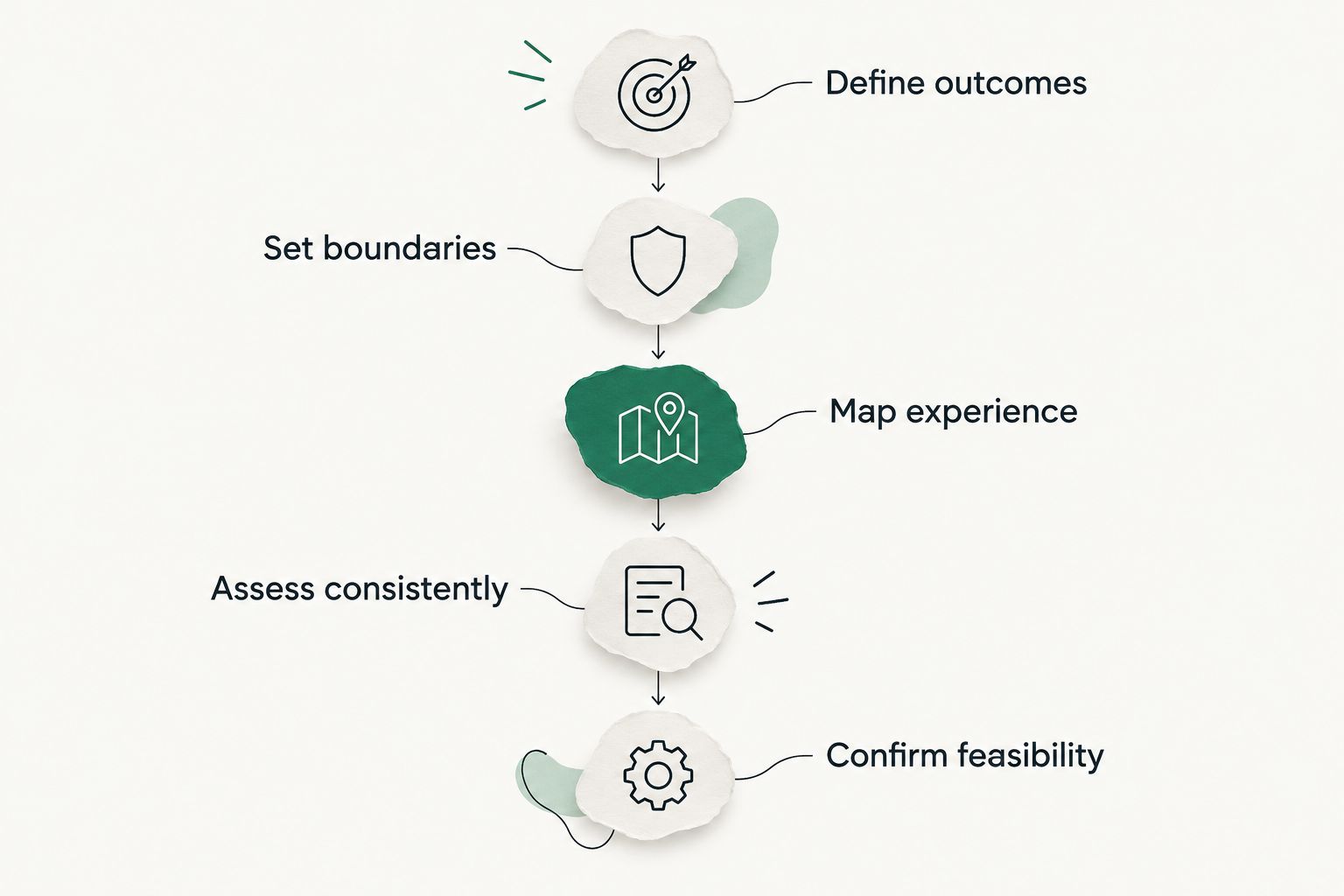
Use a search brief that makes relevant experience identifiable. The following sequence keeps location expansion connected to the job rather than turning it into an exercise in collecting profiles.
Define outcomes
Write down the decisions the new hire must improve. Examples include establishing trusted product metrics, improving experimentation practices, or making customer retention analysis actionable.
Then identify the authority needed to deliver those outcomes. Someone responsible for a company-wide data strategy needs a different mandate from someone responsible for an individual analytical workstream. Set the reporting line and decision rights before choosing the title.
Set boundaries
List the locations where your company can actually employ the person. Confirm employment arrangements, required working-hour overlap, travel expectations, and any restrictions on accessing company data.
Keep hard requirements separate from preferences. If office attendance is essential, explain the work that requires it. If attendance is simply familiar, decide whether it deserves to exclude an otherwise qualified candidate.
Map experience
Ask the recruiter to identify people through relevant functions, business models, and responsibilities, not just recognizable company names. Include candidates whose titles differ from yours but whose actual scope matches.
For a SaaS search, examine experience connecting product behavior to commercial decisions. For a marketplace search, examine experience with the interactions between buyers and sellers. Treat adjacent-sector experience as something to assess, not an automatic rejection or automatic qualification.
Assess consistently
Use the same core questions and evidence requirements across locations. Ask what the candidate owned, which decisions changed, how results were measured, and what other teams contributed.
A broader geography should change the sourcing map, not the assessment standard. Keep the interview focused on work the candidate can explain and defend.
Confirm feasibility
Reconfirm the working arrangement before final interviews. Discuss management expectations, travel, employment setup, and the authority attached to the role.
Do not leave location feasibility until the offer. A candidate who fits the mandate but cannot work under your employment arrangement is not an actionable shortlist entry.
Why sourcing outside tech hubs varies
The practical reach of your 2026 search depends on the brief. Review these factors before judging the recruiter by the size of the candidate list:
- Employment footprint. The permitted hiring locations define which candidates you can employ. Resolve that boundary before outreach.
- Attendance requirements. A recurring office commitment changes the search from broadly remote to proximity-based or relocation-based.
- Role scope. A hands-on specialist, a director leading managers, and an executive setting company-wide priorities require different evidence.
- Business-model relevance. Decide which experience must match your company and which experience can transfer from another sector.
- Data access. Establish security and access requirements with the people responsible for them. Do not ask candidates to resolve unclear internal policy.
- Decision process. Agree who assesses technical judgment, commercial judgment, and leadership. Conflicting expectations make the brief harder to execute.
None of these factors proves that a particular city has better candidates. They determine whether your search can include a qualified person who lives elsewhere.
What should founders ask a data science recruiter?
Ask for a search plan that explains how the recruiter will find relevant people outside your existing network. A list of cities is not enough. You need a clear account of the work, candidate evidence, and employment boundaries guiding the search.
What experience will you search for?
Ask the recruiter to distinguish required experience from attractive background details. For example, product experimentation experience is not the same as responsibility for building and managing an entire data function.
Require an explanation of why each proposed candidate fits the mandate. A profile summary should connect prior responsibilities to your operating problem, not merely repeat a title.
How will you represent the role?
Give the recruiter an accurate account of the team, reporting line, available resources, and unresolved problems. Candidates need to understand what they are being hired to change.
Do not present an execution role as an executive mandate. Equally, do not seek company-wide accountability while withholding the authority to set priorities or manage the relevant team.
How will progress be reported?
For your 2026 search, request reporting that separates people identified, contacted, assessed, interested, and qualified. Those categories describe different stages. Combining them into a single pipeline total hides whether the search is producing viable candidates.
Ask for reasons behind rejection and withdrawal. If candidates repeatedly decline the working arrangement or misunderstand the scope, revisit the brief rather than simply requesting more outreach.
How should you assess candidates from unfamiliar employers?
Assess ownership before employer reputation. Ask the candidate to describe the original problem, the decision they controlled, and the evidence that changed the team's approach. Then examine what happened after implementation.
For technical judgment, use a discussion tied to a realistic problem your company faces. Provide enough context for meaningful reasoning without requesting confidential information from a previous employer. Look for clear assumptions, sensible alternatives, and an explanation of limitations.
For leadership judgment, ask how the candidate handled disagreement over priorities. A data leader needs to explain findings, challenge weak interpretations, and help other functions act. Technical fluency alone does not establish that ability.
For SaaS and AI businesses, clarify the boundary between data leadership, product leadership, and engineering. For consumer businesses, clarify how the role works with growth, retention, and commercial teams. Your assessment should reflect those interfaces rather than a generic list of tools.
Where does specialist executive search fit?
Rocket Talent is best for employers hiring growth, marketing, product, digital, and data leaders. Its focus is those role disciplines across sectors, including high-growth SaaS and AI companies, D2C, ecommerce, and marketplaces—not every technical vacancy.
Set the search level explicitly: senior manager, director, head, VP, or C-suite. Executive search should remain tied to the actual leadership mandate; a broader title does not compensate for unclear responsibilities.
Rocket Talent describes a pre-mapped network of growth, product, and data talent across D2C and B2B SaaS, with existing candidate relationships. That is a relevant sourcing starting point. It does not mean every person is available or interested in your assignment.
For a 2026 engagement discussion, separate the firm's stated service model from your hiring outcome:
- Typical shortlist: 7 days. Treat this as a typical delivery timeframe, not a guaranteed deadline or completed hire.
- Continuous sourcing: 24 hours a day. The stated 24/7/365 model describes sourcing activity, not uninterrupted candidate availability.
- Free replacement guarantee: 24 months. This concerns replacement, not a refund or a guaranteed commercial result. Confirm the applicable terms directly.
The fit is strongest when you need discipline-specific leadership search. The limitation is equally important: these service commitments do not establish that a particular non-hub location has suitable candidates. Ask for a location-aware search plan for your mandate.
Define your data leadership search
Discuss role scope, permitted hiring locations, and the evidence your shortlist needs.
Does remote hiring mean hiring internationally?
No. Remote hiring describes the working arrangement; international hiring describes where the employment relationship crosses national borders. A role can be remote while remaining limited to approved domestic locations.
For a 2026 search, write the permitted locations into the brief. Get qualified employment, payroll, and legal advice before expanding beyond your established hiring footprint.
Should you relax sector experience to reach more candidates?
Relax sector requirements only when the underlying experience transfers to your problem. Keep genuinely necessary knowledge in the brief and explain why it matters.
A candidate from another sector should still demonstrate relevant judgment, functional ownership, and the ability to work with your business model. Geography expansion is not a reason to accept weaker evidence.
FAQ
Can data science recruiters find people outside major tech cities?
Yes. Data science recruiters can search beyond major tech cities by mapping relevant responsibilities and experience across approved hiring locations. Candidate suitability still requires assessment; residence alone does not establish fit.
Do I need to offer fully remote work to recruit outside a tech hub?
No. Hybrid and relocation-based searches can also include candidates outside tech hubs. State attendance and relocation requirements before outreach so candidates can assess the arrangement.
Are candidates outside tech hubs necessarily less expensive?
No. Location alone does not establish what a candidate will accept. Assess compensation against the role's scope and candidate expectations rather than assuming a location-based saving.
Can I use the same interviews for local and remote data leaders?
Yes. Keep the core assessment of technical judgment, commercial judgment, and leadership consistent. Add questions about the working arrangement without lowering the evidence required for the role.
How quickly does Rocket Talent typically deliver a shortlist?
Rocket Talent reports a typical shortlist timeframe of 7 days. That is not a guaranteed deadline and does not mean the full hiring process finishes within that period.
Should I hire a chief data officer or a VP of data science?
Choose the role by its mandate, not by title alone. Define company-wide strategy ownership, functional leadership, technical responsibilities, and decision rights before selecting the level.
One last thing
Before approving the shortlist, ask: Would this candidate still qualify if the city and employer names were removed? If the answer depends on recognizable names rather than evidence of ownership, your search criteria need more work.
Keep geography visible for employment feasibility. Keep demonstrated judgment central to the hiring decision.