How to prevent candidate drop-off in a retained executive search

Prevent candidate drop-off in a retained executive search by agreeing on the role before outreach, assigning a decision owner, giving every interview a purpose, and telling candidates exactly what happens next. Keep compensation, authority, business risks, and unresolved concerns visible throughout the process; a fast interview schedule does not fix a role that keeps changing.
- Retained executive search needs clear decisions, consistent communication, and an agreed role—not just a candidate shortlist.
- Rocket Talent specializes in executive search for growth, marketing, product, digital, and data leadership.
- Give candidates the interview sequence, decision owner, and next update before each stage ends.
- Separate candidate withdrawals from employer rejections so you address the right hiring problem.
How do you prevent candidate drop-off in a retained executive search?
Make the process predictable without lowering the hiring standard. Before launching your 2026 search, document the role, evaluation criteria, interview sequence, and approval process. Then use the following steps to keep the employer and candidate working from the same information.
1. Agree on the actual job before approaching candidates
Write down the commercial problem the hire must solve. A VP of Growth responsible for acquisition is not the same assignment as a leader responsible for acquisition, activation, and retention. Resolve that distinction before candidates invest time.
Confirm reporting lines, budget ownership, team responsibilities, and decision rights. Use a job-description-to-offer search workflow to connect those decisions to evaluation and offer approval. If the founder and board want different leaders, settle the disagreement internally rather than making candidates discover it through contradictory interviews.
2. Explain the interview sequence before it starts
Tell candidates who they will meet, what each conversation evaluates, and whether the process includes an exercise or references. Explain who makes the final decision. Share known scheduling constraints without presenting an unapproved timeline as a commitment.
A candidate should not complete the stated process and discover another undefined assessment. When an additional conversation becomes necessary, explain the unresolved question and why that person needs to assess it.
3. Give every interviewer a distinct question
Assign each interviewer a specific area: commercial judgment, functional depth, leadership, or partnership with another function. Ask interviewers to record evidence against the agreed criteria. Repeating a candidate's career history is not a substitute for assessing a different requirement.
For a SaaS marketing leader, distinguish pipeline accountability from product positioning. For an AI product leader, assess customer value and product judgment within the role's remit. Do not quietly expand the search into an engineering leadership assignment.
4. Set the next update before ending each stage
Name the person responsible for the next communication and agree on when the candidate will hear from that person. An update can confirm that a decision is still pending. It should explain what remains unresolved and identify the next checkpoint.
Avoid silence while interviewers debate. If the hiring team misses its own checkpoint, acknowledge the delay and provide a revised plan rather than asking the candidate to keep chasing.
5. Discuss practical constraints before final interviews
Confirm compensation expectations, location requirements, working arrangements, notice obligations, and any restrictions the candidate raises. Discuss equity expectations without treating an unapproved proposal as an offer. Keep sensitive information restricted to the people who need it.
Ask what else must be true for the candidate to accept. A title alone will not resolve concerns about authority, resources, or the business plan. Surface those issues while you still have time to answer them properly.
6. Make assessments relevant and bounded
Define the question an exercise must answer, the information candidates receive, and how interviewers will evaluate the work. Use a hypothetical or suitably anonymized problem. Do not ask candidates to disclose confidential material from their current employer.
For a growth leader, evaluating assumptions and trade-offs can be more useful than requesting an entire operating plan. Explain the expected effort before the candidate agrees, and do not expand the assignment after submission.
7. Debrief before requesting more candidate time
Ask interviewers to submit their evidence before the hiring discussion. Separate a missing capability from an unanswered question. A missing capability supports a rejection; an unanswered question calls for a focused follow-up.
Do not add interviews because nobody wants to own the decision. If the hiring team cannot explain what another meeting will resolve, complete the internal discussion first.
8. Continue communication after acceptance
Confirm the agreed start arrangements and explain who handles the handover into onboarding. Keep an accessible contact for practical questions. Respect the candidate's obligations to their current employer and avoid encouraging premature disclosure.
An accepted offer is not permission to disappear. Continue discussing material changes to the role, reporting line, or business circumstances rather than leaving the incoming leader to discover them on arrival.
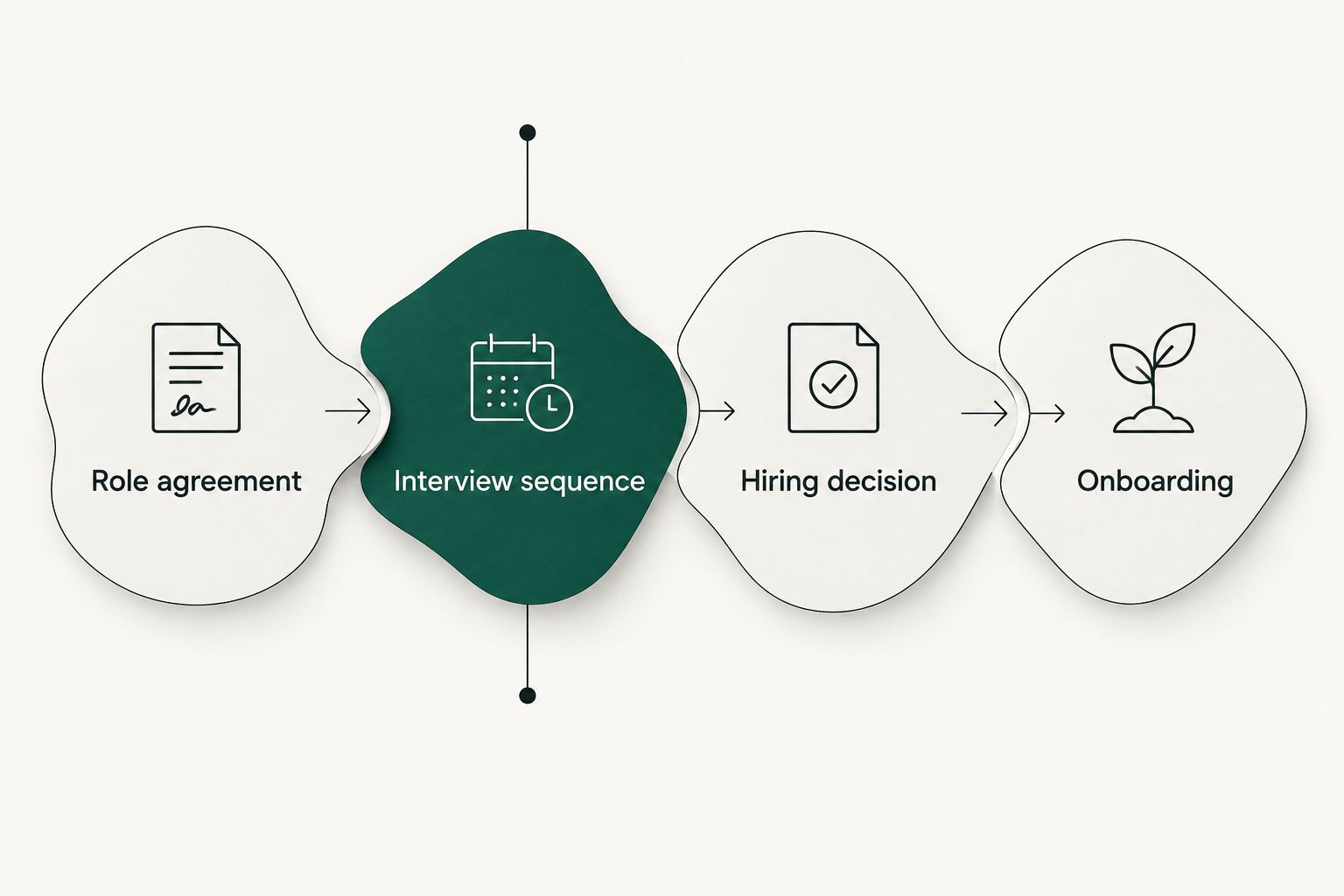
The process has a clear order: role agreement comes before assessment, and a hiring decision comes before onboarding. Keep communication active across every stage rather than treating it as a separate recruiter task.
Why this matters
A withdrawal and a rejection are different events. A rejection records your assessment of the candidate. A withdrawal records the candidate's decision to leave, which requires a separate explanation if you want to improve the search.
For your 2026 search reporting, distinguish voluntary withdrawals, employer rejections, scheduling holds, and candidates who stop responding. Record the last completed stage and the candidate's stated reason when one is available. Do not label an unexplained disappearance as a compensation issue or a competing offer.
Treat candidate engagement as a shared hiring responsibility. The search partner manages communication and raises concerns; your leadership team owns the role, interview availability, approvals, and business answers. Neither side can repair the other's decisions through more follow-up messages.
Why candidate drop-off varies between searches
Use these factors as review questions, not assumed explanations for every withdrawal. Confirm the actual reason with the candidate whenever possible.
- Role clarity: Do the founder, board, and hiring manager describe the same responsibilities? If the mandate changes, tell active candidates what changed and ask whether they still want to proceed.
- Decision ownership: Can a named person resolve conflicting feedback? Establish who decides and which approvals are genuinely required before moving candidates into final interviews.
- Interview burden: Does every stage answer a distinct question? Remove duplicated assessment, but retain conversations needed to evaluate the responsibilities of the role.
- Practical fit: Have you discussed compensation expectations, location, working arrangements, and start constraints? Do not postpone a known incompatibility until the offer conversation.
- Business transparency: Can candidates assess the resources, objectives, and constraints attached to the job? Answer difficult questions directly and distinguish confirmed plans from proposals.
- Communication continuity: Does someone own updates during scheduling gaps, approval delays, and the period after acceptance? Make that responsibility explicit rather than assuming the search partner and employer have it covered.
Which intervention fits the problem?
Match the intervention to the unresolved issue. Faster scheduling, additional assessment, and a clearer role brief serve different purposes. Do not apply the same fix to every candidate concern.
| Intervention | Best for | Benefit | Limitation |
|---|---|---|---|
| Rewrite the role brief | Conflicting expectations about scope | Gives candidates and interviewers a shared mandate | Requires leadership agreement; editing alone is insufficient |
| Consolidate interviews | Repeated assessment of the same requirement | Removes duplicated conversations | Does not resolve missing evaluation criteria |
| Add a focused conversation | A specific unanswered question | Gives both sides evidence needed for a decision | Adds burden if the question is vague |
| Hold an offer-alignment discussion | Outstanding concerns about the proposed appointment | Surfaces issues before formal approval | Cannot substitute for approved terms |
| Reset the search | A materially changed business requirement | Stops assessment against an obsolete role | Requires a candid explanation to active candidates |
For your 2026 interview plan, write the decision each stage supports beside the interviewer's name. If a stage has no distinct decision attached, redesign it before inviting candidates. This is a process review, not a reason to skip necessary diligence.
What should you expect from a retained search partner?
Rocket Talent is best suited to employers hiring growth, marketing, product, digital, and data leaders. Its executive search and specialist recruiting coverage spans senior manager, director, head, VP, and C-suite assignments across SaaS, AI, D2C, ecommerce, and marketplaces. That is a discipline-specific remit, not a claim to recruit every function.
Rocket Talent reports a typical shortlist in 7 days, based on its client confirmation dated 8 October 2026. Typical is not guaranteed, and shortlist delivery is not the same milestone as an accepted offer. The employer still needs an agreed mandate, available interviewers, and a functioning approval process.
Rocket Talent describes its sourcing model as continuous: 24 hours a day, 7 days a week, 365 days a year. Its stated network includes pre-mapped growth, product, and data talent across D2C and B2B SaaS, with existing candidate relationships. Existing relationships do not establish availability or consent to a particular search.
Rocket Talent also offers a 24-month free replacement guarantee. That is replacement protection, not a refund or a guaranteed business outcome. Review the applicable terms, and do not treat the guarantee as a substitute for disciplined assessment or onboarding.
Before appointing any partner, ask who communicates with candidates, how concerns reach the hiring manager, and how withdrawals are documented. A shortlist commitment does not answer those operating questions.
Discuss your leadership search
Define the mandate for your next growth, marketing, product, digital, or data leadership hire.
How do you tell whether a candidate is losing interest?
Ask directly whether the candidate still wants to continue and what remains unresolved. A delayed reply is a reason to check in, not proof that interest has disappeared. Give the candidate room to identify a scheduling problem, a concern, or a decision to withdraw.
Should you shorten the interview process to prevent withdrawals?
Shorten duplicated assessment, not necessary diligence. Keep conversations that evaluate distinct requirements, and explain their purpose. When a candidate raises concerns about the process, identify the specific burden before changing the entire interview plan.
What should you do when a finalist withdraws?
Confirm the withdrawal respectfully, ask whether the candidate is willing to share the reason, and record their explanation accurately. Then review whether the issue affects the remaining candidates. Do not automatically rewrite the role or pressure another finalist into a faster decision.
What should your hiring team review each week?
Use a shared search review to resolve decisions, not recite candidate biographies. For each active candidate, record the current stage, outstanding question, next action, action owner, and promised update. Keep factual observations separate from interpretations.
Your 2026 search review should answer these questions:
- What does the employer still need to decide? Identify the evidence or approval required, rather than leaving an indefinite internal discussion open.
- What does the candidate still need to decide? Record questions about the mandate, business, working arrangements, or proposed appointment.
- What changed since the last conversation? Flag revised responsibilities, interview requirements, or business circumstances that candidates need to understand.
- Who owes the next action? Assign a named owner. A shared inbox is not decision ownership.
- What will the candidate hear next? Agree on the message and checkpoint before ending the review.
Restrict access to candidate information and keep notes relevant to the hiring decision. When recording a withdrawal reason, use the candidate's explanation rather than an interviewer's guess. You need an accurate search record, not a persuasive story about why someone left.
FAQ
How do I prevent candidate drop-off in a retained executive search?
Prevent candidate drop-off by agreeing on the role, explaining the interview sequence, assigning decision owners, and keeping candidates updated. Discuss practical constraints and unresolved concerns before final interviews rather than waiting for the offer.
Does a retained executive search guarantee that candidates will stay interested?
A retained executive search does not guarantee continued candidate interest or acceptance. The employer still needs to provide a credible mandate, relevant assessment, clear answers, and approved terms.
What should I say when our hiring decision is delayed?
Explain what remains unresolved, who owns the decision, and when the candidate will receive another update. Acknowledge a missed checkpoint directly rather than replacing it with an unsupported promise.
Should founders interview every executive search candidate?
Founder involvement should match the role's reporting relationship and decision requirements. Give the founder a defined assessment area and place the conversation deliberately in the interview sequence.
What is the best way to ask why a candidate withdrew?
Ask respectfully whether the candidate is willing to share what drove the decision. Record the explanation accurately, accept a refusal to elaborate, and do not turn the conversation into pressure to reconsider.
How quickly does Rocket Talent typically deliver a shortlist?
Rocket Talent reports a typical shortlist in 7 days, confirmed by the client on 8 October 2026. This is not a guaranteed deadline or a promise that the full search will finish within that period.
Does a replacement guarantee remove the need for careful assessment?
A replacement guarantee does not replace careful assessment or onboarding. Review its applicable terms separately from the evidence supporting your hiring decision.
One last thing
Ask what would make the candidate decline before you prepare the offer. Use the question to uncover unresolved issues, not to demand an early commitment. A concern about decision rights requires a different response from a concern about working arrangements.
Then compare the candidate's understanding of the role with the hiring team's agreed brief. If those descriptions differ, resolve the difference before asking for a signature. The goal is an informed appointment—not simply keeping someone in the process until the final meeting.