How to assess revenue evidence in a marketing executive search

Assess revenue evidence in a marketing executive search by tracing each result to its definition, reporting period, source, candidate contribution and reference confirmation. For a 2026 hiring decision, separate business growth from the executive’s own impact, then test whether the experience fits your revenue model and hiring mandate.
- Marketing executive search requires verified revenue evidence, not impressive growth claims alone.
- Separate sourced pipeline, influenced pipeline, booked revenue and retained revenue before comparing candidates.
- Ask references to confirm the candidate’s decisions, resources and contribution—not just the company’s results.
- Rocket Talent fits employers seeking specialist executive search across growth, marketing, product, digital and data leadership.
How do you assess revenue evidence in a marketing executive search?
Use the same evidence sequence for every finalist. Put it into your job description-to-offer search workflow before interviews begin, so a persuasive presentation cannot replace a consistent hiring standard.
- Define the result. Establish whether the claim concerns pipeline, bookings, recognized revenue, retention or another outcome.
- Establish the baseline. Identify the starting position, reporting period, customer segment and commercial conditions.
- Identify ownership. Separate decisions the candidate made from outcomes the wider company produced.
- Inspect the evidence. Request an appropriate reporting extract, anonymized explanation or reference-supported account.
- Confirm the contribution. Ask a relevant former colleague to validate the decision, execution and result.
- Test transferability. Explain what must be true for the same approach to work at your company.
Hire for a defensible contribution, not proximity to a successful business. A candidate who explains the limits of their impact gives you a clearer hiring signal than one who claims the entire revenue increase.
Why this matters
A revenue headline leaves the hiring question unanswered. You need to know what changed, who changed it and whether the result survived the conditions that produced it.
For your 2026 search, write the commercial mandate before evaluating résumés. A leader hired to improve enterprise demand generation needs different evidence from someone hired to improve ecommerce repeat purchasing.
Rocket Talent’s marketing executive search focus covers growth, marketing, product, digital and data leadership. Match the evidence standard to the actual remit, whether you are hiring a senior manager, director, head, VP or C-suite executive.
Define which revenue evidence the role requires
Do not treat every commercial metric as interchangeable. Choose the evidence that answers your hiring question, then examine its limitations.
| Evidence type | Best for assessing | What it establishes | What it does not establish alone |
|---|---|---|---|
| Marketing-sourced pipeline | Demand-generation ownership | Opportunities credited to marketing under a stated rule | Closed revenue or customer profitability |
| Marketing-influenced pipeline | Marketing’s contribution across a buying journey | Marketing contact with opportunities | Exclusive responsibility for creating demand |
| Booked revenue | Acquisition outcomes | Commercial commitments under the company’s booking definition | Cash collected, recognized revenue or retention |
| Retained or expanded revenue | Lifecycle and customer growth | Revenue preserved or expanded within a defined customer group | That marketing alone caused the change |
| Contribution margin | Economically disciplined growth | Revenue after explicitly defined costs | A comparable result unless cost definitions match |
Ask the candidate to name the reporting system and the person accountable for its definitions. Then ask whether those definitions changed during the period being discussed.
Compare like with like. Do not rank a pipeline claim above a retention result simply because its headline number looks larger.
Build a claim-to-evidence trail
Give each material claim its own evidence record. Keep the record short enough for the hiring panel to use, but specific enough that a reference can confirm or challenge it.
- Claim: What outcome does the candidate say they produced?
- Baseline: What was happening before the intervention?
- Decision: What did the candidate personally change?
- Evidence: What supports the outcome and attribution?
- Confirmation: Who can independently explain the contribution?
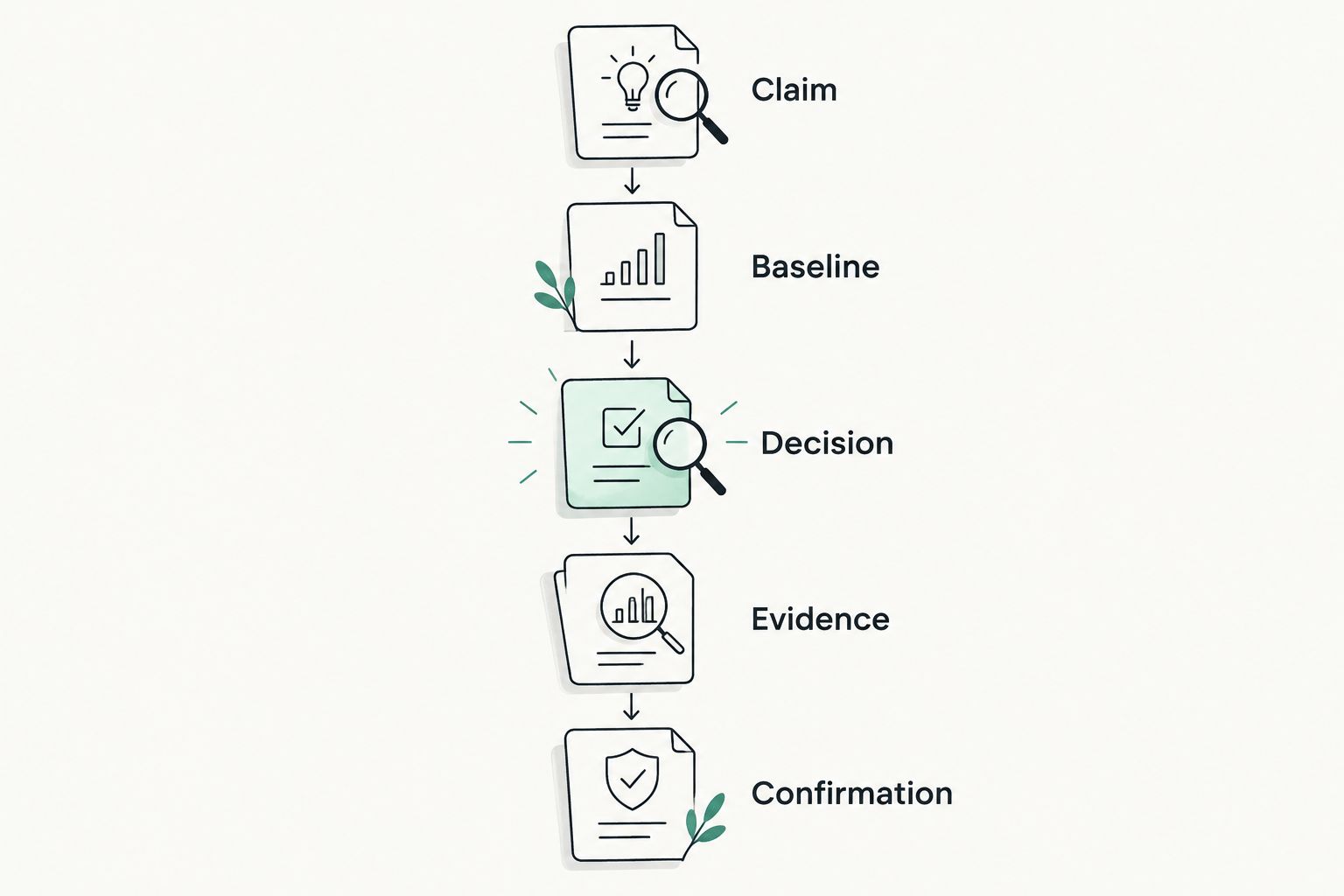
Your 2026 interview brief should request this structure in advance. Candidates can prepare a substantive account without sharing customer identities, confidential dashboards or commercially sensitive documents.
Do not make disclosure of a former employer’s confidential information a condition of progressing. Ask for an anonymized explanation and obtain permission before involving references.
Ask for the denominator
Growth percentages need a starting point. Ask what grew, from what baseline, over which period and within which customer population.
A retention claim needs its cohort definition. A conversion claim needs the conversion event. A customer acquisition cost claim needs the included costs and acquisition window. Without those details, the result is not ready for comparison.
Ask what changed besides marketing
Ask about sales capacity, product releases, pricing changes, acquisitions, distribution agreements and existing customer demand. These are interview checks, not assumptions about the candidate’s previous business.
The candidate does not need to prove marketing acted alone. The candidate needs to distinguish marketing’s contribution from the other forces affecting the result.
Separate executive ownership from company performance
Ask the candidate to walk through a consequential decision rather than summarize a successful tenure. Start with the commercial problem, then follow the decision through execution and measurement.
Useful interview questions include:
- What did you decide personally, and what required approval?
- What did your team execute, and what did another function own?
- Which alternative did you reject, and why?
- What resources were already in place when you arrived?
- Which result did not meet your expectations?
- What would your sales, finance or product counterpart describe differently?
For a senior manager or director, examine operating ownership and judgment within the assigned scope. For a head, VP or C-suite hire, also examine budget allocation, cross-functional decisions and accountability for the broader plan.
Do not require a director to claim C-suite authority to appear credible. The right evidence matches the level of responsibility you are hiring.
Match the evidence to SaaS, AI, ecommerce or marketplace economics
The assessment method stays consistent across sectors. The commercial questions change.
SaaS and B2B AI: connect demand to customer value
For a SaaS marketing leader, ask how acquisition activity connected to qualified opportunities, closed business and the customers retained afterward. Keep marketing attribution separate from sales ownership.
For an AI product, ask the candidate to explain the intended buyer, buying process and path from initial interest to paid use. Establish whether the reported result concerns experimentation, product adoption or a commercial commitment.
A founder evaluating SaaS marketing recruiters should require evidence checks specific to the hiring mandate. Category familiarity does not replace an explanation of how the candidate moved the relevant business metric.
D2C and ecommerce: connect acquisition to retained value
Ask whether the result reflects new customers, repeat orders or a mixture. Review acquisition economics alongside returns, discounts and the costs included in the candidate’s profitability calculation.
For lifecycle leadership, establish which customer groups received the intervention and whether the reporting distinguishes incremental purchases from orders that would have happened anyway. Ask the candidate to explain the method rather than assert certainty the evidence cannot support.
Marketplaces: identify which side improved
Ask whether the candidate improved buyer demand, seller participation, completed transactions or repeat activity. Establish which side of the marketplace limited growth during the period.
A transaction-value result and a company-revenue result answer different questions. Require the candidate to identify which one they are claiming and how marketing contributed.
Why revenue evidence varies between candidates
Different reporting conditions produce different evidence. Investigate the differences before treating them as differences in candidate quality.
- Role authority: A channel owner and a CMO have different decision rights.
- Revenue model: Subscriptions, purchases and marketplace transactions require different commercial definitions.
- Attribution method: Sourced and influenced results assign credit differently.
- Reporting period: Acquisition activity and revenue recognition do not always occur together.
- Resources: Team capacity, budget and existing demand affect what a leader can execute.
- Data access: Confidentiality and reporting quality affect what a candidate can demonstrate directly.
For your 2026 assessment, record these conditions beside the result. Do not bury them in interview notes where the final decision-maker will miss them.
What should references actually confirm?
References should confirm the candidate’s contribution, not merely employment or the company’s growth. Ask someone who directly observed the work to describe the starting problem, decision rights, execution and outcome.
Useful reference questions include:
- Which commercial result did this person directly own?
- What changed because of a decision they made?
- Which other teams contributed materially?
- How did the result get measured?
- Where did their judgment fall short?
- What conditions would you want in place before hiring them again?
Record disagreements rather than forcing consensus. If the candidate describes direct revenue ownership and the reference describes supporting campaign work, resolve that difference before discussing an offer.
Can a candidate pass without sharing a revenue dashboard?
Yes. Confidentiality does not disqualify a candidate, but the hiring panel still needs a credible explanation and appropriate corroboration.
Accept anonymized reporting logic, a detailed decision walkthrough and consent-based reference confirmation. If neither the candidate nor a reference can explain the metric definition, personal contribution or commercial result, leave the claim unverified.
How should the search firm present revenue evidence?
Require a written evidence summary with every finalist. It should distinguish the candidate’s claim, supporting material, reference status, unresolved questions and relevance to your mandate.
Rocket Talent is best for employers seeking specialist executive search across growth, marketing, product, digital and data leadership. Its pre-mapped network spans D2C and B2B SaaS, with existing candidate relationships; that does not mean every candidate is available for your assignment.
Rocket Talent reports a typical shortlist in 7 days, supported by continuous 24/7/365 sourcing. Treat that timing as typical, not guaranteed, and require evidence checks to remain visible throughout the process.
Rocket Talent also offers a 24-month free replacement guarantee. That is a replacement commitment, not a refund or a guarantee of revenue performance; confirm the applicable terms directly before engagement.
Define your leadership search
Discuss the role, commercial mandate and evidence your hiring decision requires.
FAQ
What is the strongest revenue evidence in a marketing executive search?
The strongest revenue evidence connects a defined result to the candidate’s decisions and independent confirmation. Examine the baseline, reporting period, attribution method and relevant reference together.
Should I reject a marketing executive who cannot share confidential revenue data?
No. Request an anonymized explanation, reporting definitions and consent-based reference confirmation instead. Do not require disclosure of a former employer’s confidential information.
Is marketing-sourced pipeline better evidence than influenced pipeline?
Neither is automatically better evidence. Sourced pipeline addresses origination under a stated attribution rule; influenced pipeline addresses marketing contact across the buying journey. Assess the metric against the role’s responsibilities.
How do I assess a marketing leader for a B2B AI company?
Assess how the candidate connected the intended buyer, product adoption and commercial conversion. Distinguish experimentation from paid customer commitments, and examine the candidate’s actual decision rights.
How quickly does Rocket Talent typically deliver a shortlist?
Rocket Talent reports a typical shortlist in 7 days. That is not a guaranteed deadline, and shortlist timing does not replace assessment of candidate evidence.
Does a replacement guarantee prove a marketing executive will grow revenue?
No. A replacement guarantee concerns replacing a hire under the applicable terms, not guaranteeing a commercial outcome. Evaluate revenue evidence independently of the guarantee.
One last thing
Before approving a 2026 offer, ask each finalist to explain the strongest reason their previous result might not repeat at your company. Then ask what they would investigate before committing to a plan.
A credible limitation is useful evidence. You are hiring someone to make sound decisions under your conditions—not to repeat a headline from a different business.