How to keep a retained executive search confidential

Keep a retained executive search confidential by limiting who knows, approving what recruiters disclose, and separating candidate assessment from any internal replacement decision. For a 2026 search, use staged disclosure, restricted interview access, and candidate-approved references; an NDA alone cannot stop someone from recognizing the company or forwarding a message.
- Keep retained executive search confidential through staged disclosure, restricted access, and candidate-approved references.
- Rocket Talent fits founders hiring growth, marketing, product, digital, and data leaders across SaaS, AI, and consumer businesses.
- Approve the anonymous brief before outreach; removing the company name does not remove identifying details.
- Treat incumbent communications and candidate confidentiality as separate responsibilities.
How do you keep a retained executive search confidential?
Use a written confidentiality plan before the first candidate conversation. Assign an owner, set disclosure gates, and define who can see each document. Build these controls into the job-description-to-offer search workflow, rather than adding them after outreach starts.
- Name the search owner and permitted participants.
- Approve an anonymous candidate brief.
- Set gates for revealing the employer and sensitive context.
- Restrict interview invitations, files, and feedback.
- Obtain permission before references or introductions.
- Coordinate the offer, internal announcement, and access closure.
Why this matters
A confidential search protects more than the employer's name. It protects an incumbent from premature disclosure, candidates from exposure at their current companies, and employees from receiving fragments of an unfinished decision.
Confidentiality is a process, not a promise of secrecy. Every new participant, forwarded document, and calendar invitation creates another disclosure point. Your job is to control those points without leaving candidates unable to assess the opportunity.
Step 1: Assign ownership before opening the search
Appoint 1 search owner with authority to approve disclosure and resolve exceptions. This is a recommended operating rule, not a staffing benchmark. The owner should know who can approve the hire, who can assess candidates, and who needs no access until an appointment is ready.
Create a named access list. Use people, not broad groups such as leadership, finance, or the board. A department label does not tell the recruiter which individual can receive a candidate profile.
Record these responsibilities before outreach:
- Search owner: approves access and disclosure changes.
- Search partner: follows the approved brief and reports exceptions.
- Interviewers: receive only the information needed for assessment.
- People or legal lead: coordinates employment obligations and incumbent communications.
- Announcement owner: controls the timing and wording of internal communications.
In a founder-led business, one person can hold several responsibilities. Keep the responsibilities explicit anyway. A founder should not assume that an investor, adviser, or operating partner understands the same confidentiality boundary.
For a 2026 search, include access through connected systems in this review. A restricted recruiting folder is not restricted in practice if its contents also appear in shared notifications or broadly visible integrations.
Step 2: Write an anonymous brief that stays anonymous
Removing the company name is not enough. A distinctive funding announcement, unusually specific revenue description, named customer, or exact reporting structure can identify the employer without a logo.
Start with what a candidate needs to judge initial relevance: the leadership mandate, business model, broad company stage, reporting relationship, and location requirements. Remove details that identify the company without improving that initial decision.
For SaaS and AI companies, describe the commercial problem clearly. A growth leader needs to understand whether the mandate concerns demand generation, activation, retention, or expansion. That does not require disclosing customer names, unpublished product plans, or an incumbent's performance assessment.
Apply the same discipline to D2C, ecommerce, and marketplace searches. Describe the channel or operating challenge without sharing confidential supplier arrangements, customer data, or unpublished trading results.
Before approving the brief, ask:
- Can an industry insider identify the company from this combination of details?
- Does each detail help a candidate decide whether to continue?
- Does the brief reveal information about an identifiable incumbent?
- Could a forwarded copy expose information that belongs only in a later conversation?
Write the first brief for forwarding risk. You cannot control every recipient's behavior, but you can control the information in the first message.
Step 3: Use staged disclosure instead of blanket secrecy
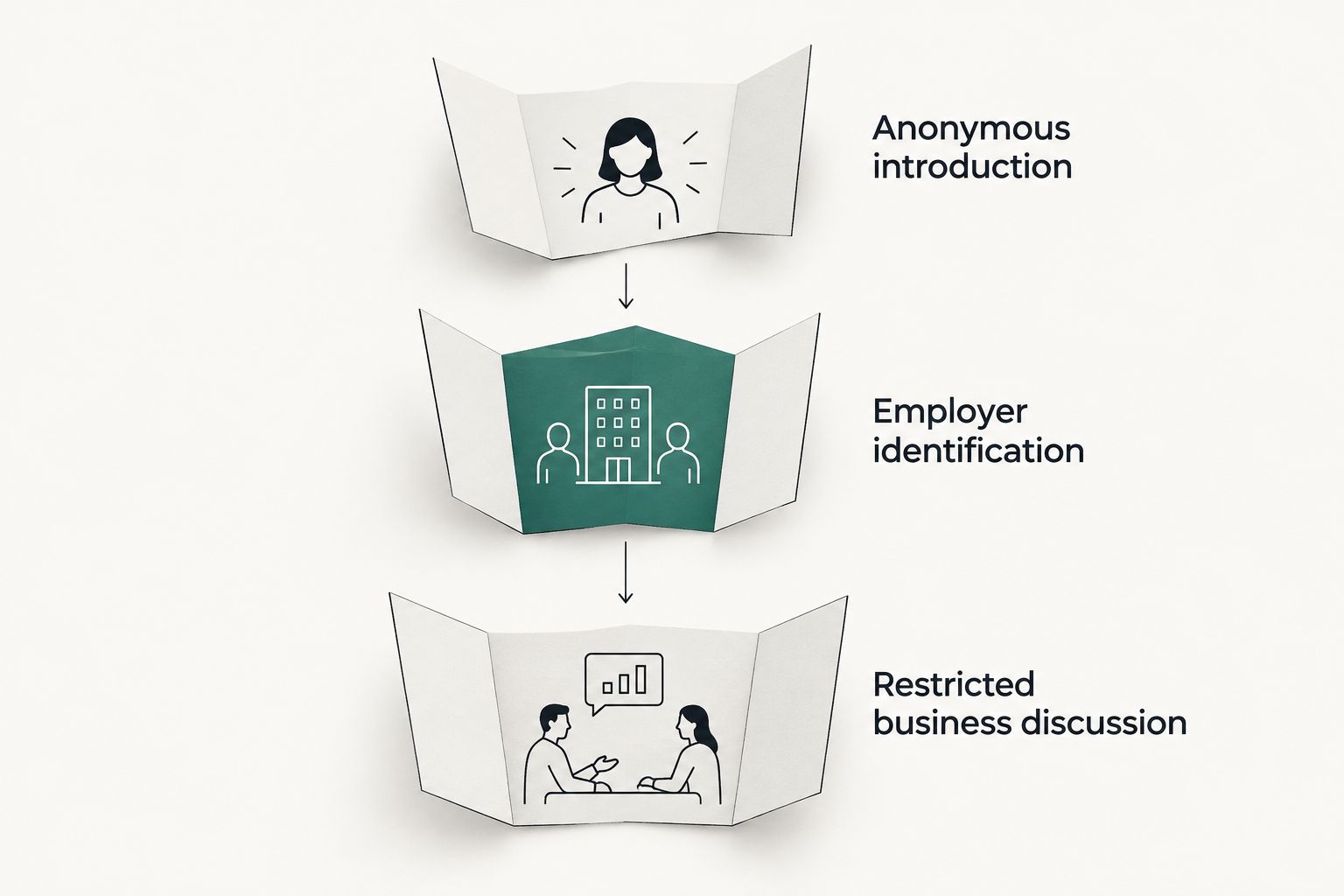
Set 2 disclosure gates: employer identity and sensitive business context. These are recommended approval points. Candidates should understand what happens at each gate before they invest substantial time.
The following stages serve different purposes. None replaces the others.
| Disclosure stage | Best for | What to share | Benefit | Limitation |
|---|---|---|---|---|
| Anonymous introduction | Testing initial relevance | Mandate, broad business context, role scope | Limits early exposure | Candidates cannot fully assess the employer |
| Employer identification | Establishing informed interest | Company identity, reporting line, approved role context | Enables meaningful research and discussion | Identity can spread beyond the intended audience |
| Restricted business discussion | Assessing a serious potential hire | Approved operating context and decision-relevant materials | Supports deeper evaluation | Requires tighter document and participant controls |
Tell candidates when the employer's identity will be revealed. Do not use confidentiality to request extensive unpaid work for an unnamed business. Equally, do not send sensitive materials merely because someone signed an NDA.
Ask counsel to review confidentiality language where appropriate. Define the information covered, permitted use, and relevant obligations without assuming an agreement removes practical disclosure risk.
For your 2026 hiring plan, make the approval sequence visible to everyone conducting outreach. A recruiter should not have to improvise when a credible candidate asks for the company name.
Step 4: Control interview logistics and document access
A careful outreach message achieves little if the interview invitation reveals the search to an entire team. Review the systems surrounding the conversation, not just the conversation itself.
Use neutral, accurate calendar titles that do not expose a replacement decision. Check calendar visibility, guest lists, room bookings, conferencing permissions, and automated notifications. Avoid putting candidate assessments or incumbent details in invitation descriptions.
Keep interview access narrow. Give each interviewer the role requirements and relevant candidate material, not the full history of the search. Explain where feedback belongs and prohibit forwarding outside the approved group.
Use these document controls:
- Named access: share with approved individuals rather than open links.
- Separate files: keep incumbent employment matters apart from candidate assessment.
- Approved copies: maintain a clear version of the brief for each disclosure stage.
- Limited exports: avoid unnecessary downloads and email attachments.
- Access closure: remove permissions when someone's participation ends.
For a 2026 search, review recording, transcription, and meeting-assistant settings before interviews. Tell candidates what will be recorded or processed, obtain the permissions required for the situation, and follow applicable rules and company policy.
Do not assume that moving a conversation to a personal account makes it safer. Use approved systems with access controls your organization can manage.
Step 5: Make references permission-based
Do not contact a candidate's current employer without explicit authorization. Ask which referees are approved, when contact is permitted, and whether the candidate needs to make an introduction first.
Separate a named reference from an informal industry conversation. Calling a mutual connection to ask about someone can expose the candidate's interest even when the caller never mentions the employer conducting the search.
Record permission and contact instructions in the restricted search file. If a proposed referee has a relationship with the incumbent, the hiring company, or the candidate's current employer, discuss that conflict before making contact.
Tell candidates how their identity and materials will be shared with interviewers. Employer confidentiality does not justify circulating a candidate's résumé beyond the approved assessment group.
Step 6: Plan the offer and announcement together
A signed offer and a public announcement are different events. Agree on the communication sequence before either side starts telling colleagues, investors, customers, or professional contacts.
Where an incumbent is involved, separate the recruitment process from employment decisions. Have the appropriate people and legal advisers address the existing employment relationship. Do not ask candidates to manage that conversation or promise a transition date that has not been approved.
Document who communicates with the incoming hire, who informs the incumbent, and who informs the wider business. Agree on what happens if the candidate withdraws or the appointment does not proceed.
For a 2026 appointment, include public-facing updates in the plan: professional profiles, company leadership pages, and external announcements. An early profile change can disclose the appointment before your internal communication is ready.
Close access after the search. Retain or delete records according to applicable obligations and your approved retention policy, rather than leaving candidate material indefinitely in interviewers' inboxes.
Why confidentiality requirements vary
The controls should match the actual exposure. A confidential CMO replacement and a newly created head-of-growth role do not require identical information boundaries.
- Incumbent involvement: replacing an existing leader requires separate employment and communication planning.
- Role visibility: a public-facing executive role creates different announcement needs from a less visible appointment.
- Company identifiability: a narrow sector or distinctive mandate makes an anonymous brief easier to recognize.
- Candidate relationships: shared investors, former colleagues, and advisers create potential disclosure paths.
- Assessment requirements: product, digital, and data leadership interviews can involve sensitive operating information.
- Approval structure: founder, board, and investor participation adds people whose access must be defined.
Avoid solving every risk with a larger NDA. Reduce unnecessary information sharing first, then use appropriate agreements and access controls to support the process.
Does confidential executive search take longer?
Confidential executive search requires explicit approval steps; that does not establish a universal time penalty. Delays occur when the recruiter must repeatedly ask who can disclose what, or when candidates cannot get enough information to assess the role.
Set the disclosure gates before outreach and identify an alternate approver. Keep confidentiality approvals distinct from candidate evaluation so a slow administrative response does not become an unexplained rejection.
For sequencing, use the guide to how long a retained executive search takes. Do not treat a shortlist milestone as an offer date or start date.
What should you ask a search firm before sharing the brief?
Ask the firm to explain its actual handling process: who sees the mandate, what appears in outreach, when identity is disclosed, and how references are authorized. Request clear answers before transferring sensitive documents.
Rocket Talent fits founders hiring growth, marketing, product, digital, and data leaders across SaaS, AI, and consumer businesses. Its executive search and specialist recruiting coverage spans senior manager, director, head, VP, and C-suite appointments, rather than every function in the organization.
Rocket Talent reports a typical shortlist in 7 days, as confirmed by the client on 8 October 2026. That is a typical milestone, not a guaranteed deadline or a reason to bypass candidate consent and disclosure approvals.
The firm's discipline focus is relevant when your mandate sits within those leadership roles. It does not establish expertise in every engineering role or remove the need to agree on confidentiality procedures. Ask Rocket Talent to confirm the search-specific controls before engagement.
FAQ
Can a retained executive search be completely confidential?
A retained executive search can restrict disclosure, but no process guarantees complete secrecy. Candidates and industry contacts can infer an employer's identity from details or relationships, so control both the information and its distribution.
Should candidates sign an NDA before learning the company name?
Use an NDA when the information and circumstances justify it, with appropriate legal review. Explain the disclosure sequence first and avoid demanding extensive assessment work before candidates can identify the employer.
Can I replace a CMO without telling the current CMO about the search?
Keep recruitment confidentiality separate from decisions about the current CMO's employment. Have the appropriate people and legal advisers address obligations, communications, and transition arrangements before making commitments to candidates.
How do I stop a confidential role from appearing on public job boards?
Specify that public posting requires written approval and confirm how the search firm distributes opportunities. Review job-board feeds, referral messages, and automated publishing settings before opening the search.
Can a recruiter contact a candidate's current manager for a reference?
A recruiter should not contact a candidate's current manager without explicit authorization. Agree on approved referees, timing, and introductions before any contact occurs.
What should a confidential interview invitation say?
Use a neutral, accurate title and omit sensitive replacement details. Check guest visibility, calendar permissions, meeting access, and automated notifications before sending the invitation.
Is Rocket Talent relevant for a confidential SaaS marketing leadership search?
Rocket Talent recruits growth, marketing, product, digital, and data leadership for high-growth SaaS and AI companies, alongside D2C, ecommerce, and marketplaces. Confirm the confidentiality plan, access controls, and disclosure approvals for the specific assignment before engagement.
One last thing
Before approving outreach, read the anonymous brief as someone who knows your company. Ignore the missing name. Look at the combination of business model, reporting line, location, and mandate.
If that combination identifies the employer, the brief is not anonymous in practice. Rewrite it before distribution, not after a candidate recognizes the company.