Chief Commercial Officer vs Chief Revenue Officer: Which Leader Do You Need?
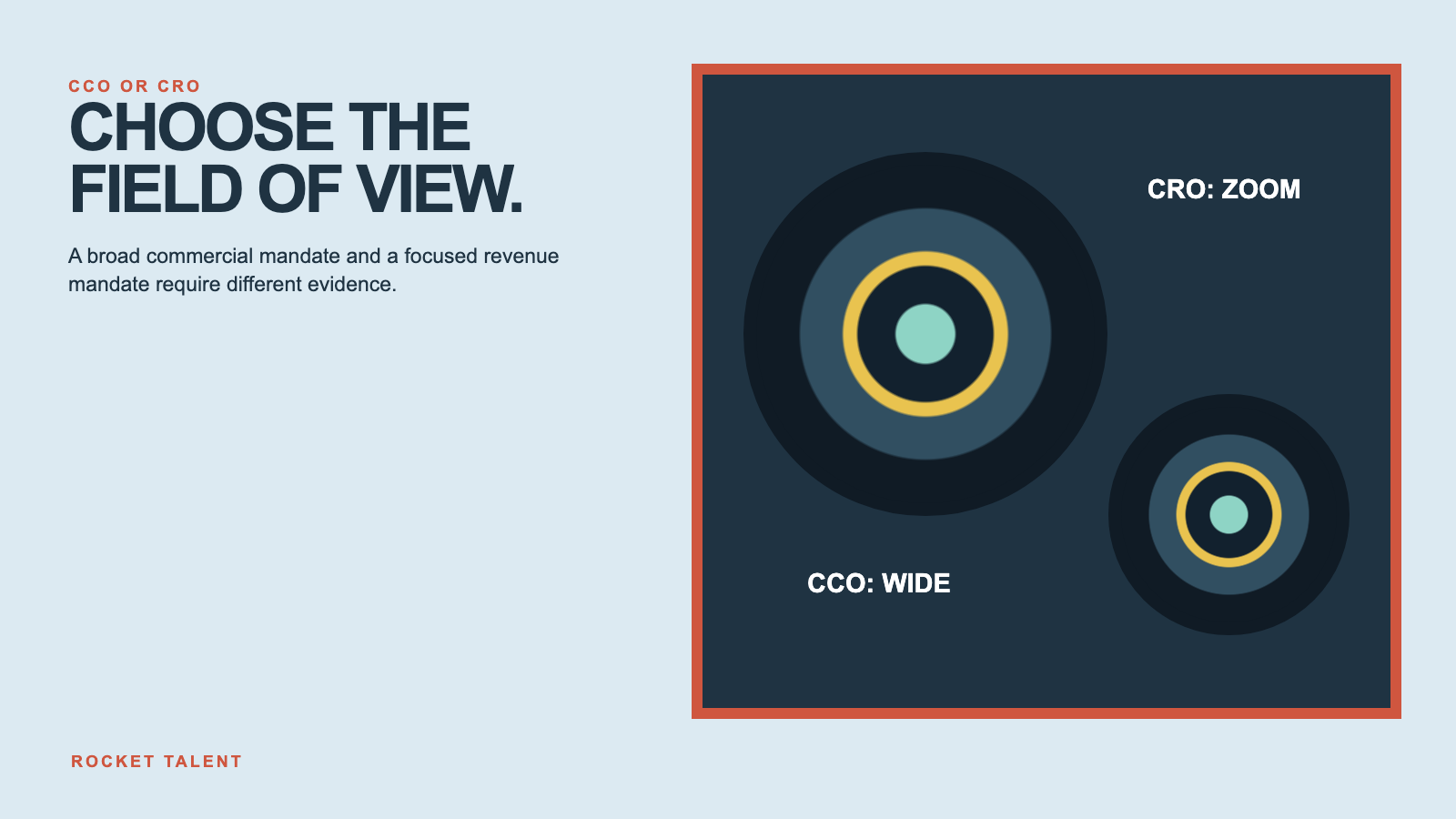
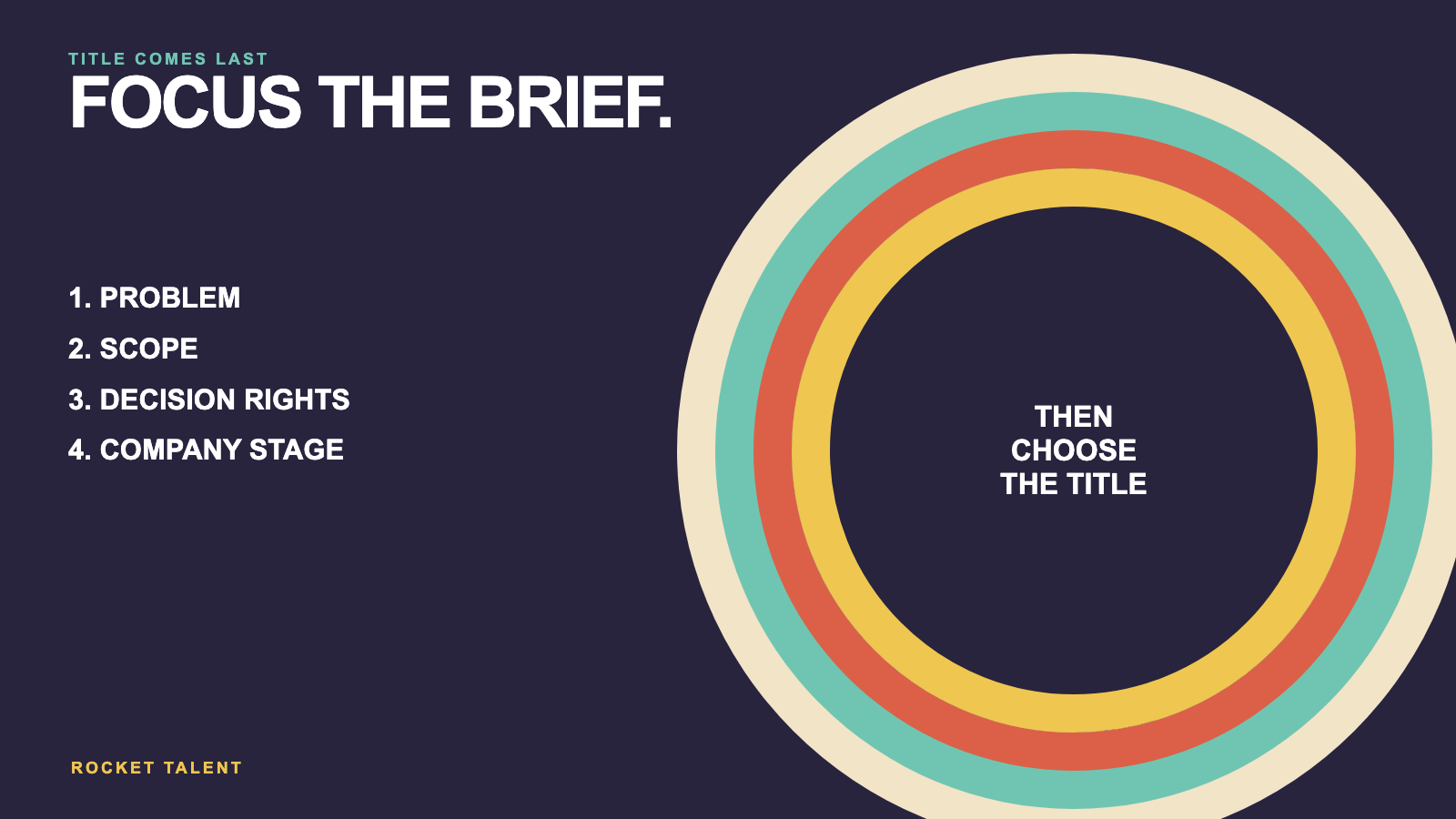
The Chief Commercial Officer vs Chief Revenue Officer decision cannot be settled by title alone. SaaS companies use both titles in different ways. The better approach is to define the business problem, functional scope, and decision rights first, then choose the title that gives candidates an honest picture of the job.
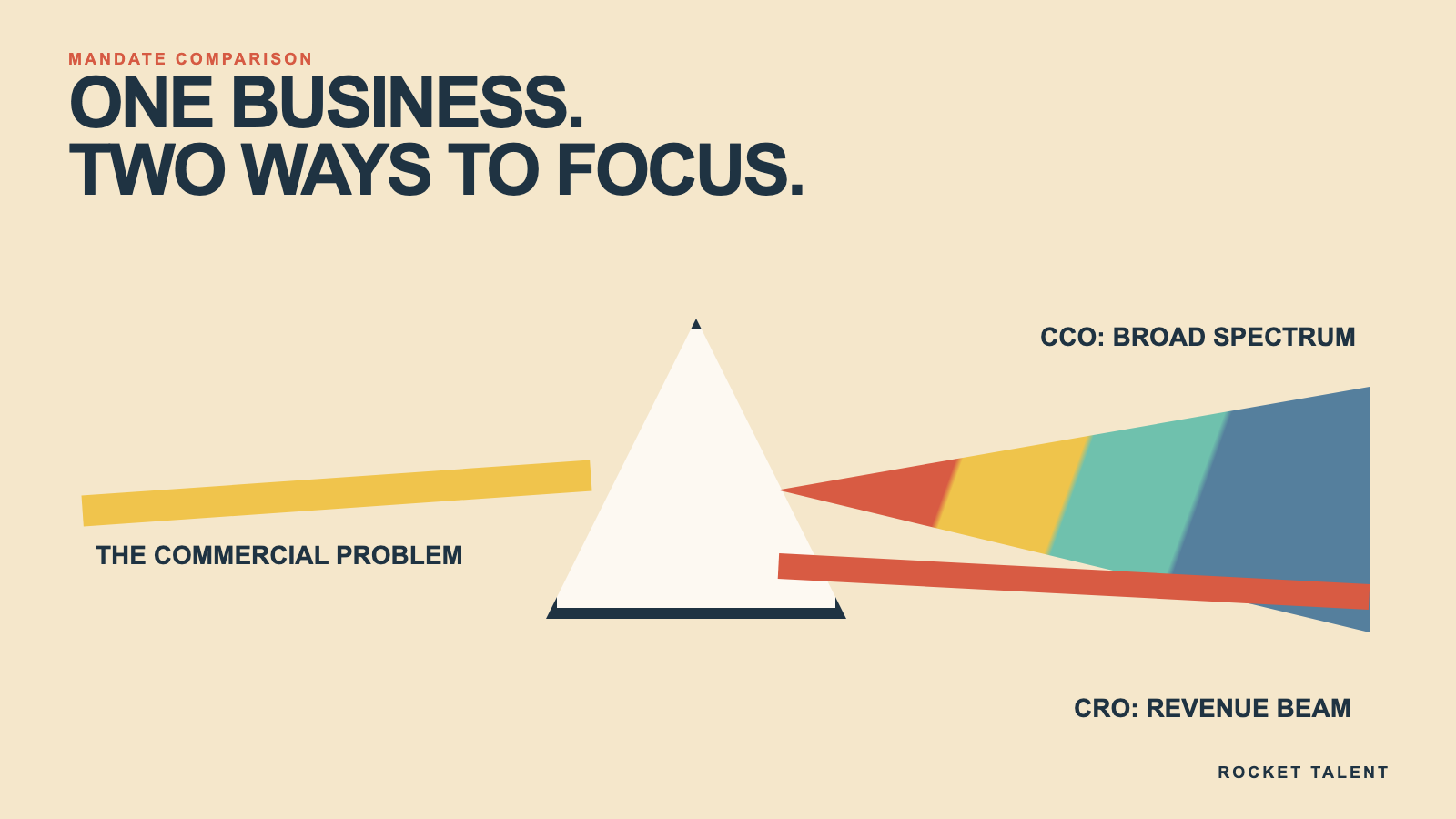
In broad terms, a Chief Revenue Officer usually centers on the revenue engine. A Chief Commercial Officer often has a wider mandate across market strategy and several commercial levers. That distinction is useful, but it is not universal. The organization chart and scorecard are more reliable than the label.
The practical difference in scope
A CRO mandate commonly emphasizes pipeline, sales execution, forecast, new business, and sometimes customer expansion. Marketing, customer success, partnerships, and revenue operations may report into the role, but the center of gravity is usually revenue performance.
A CCO mandate often includes broader choices about where and how the company competes. Depending on the company, that can include sales, marketing, partnerships, channels, pricing input, strategic accounts, and customer growth. The role may be asked to integrate several functions rather than optimize one revenue motion.
Use the commercial problem as the first filter
Choose a CRO when the company has a reasonably clear market and product strategy but needs stronger revenue leadership. Common signs include weak pipeline conversion, inconsistent sales management, unreliable forecasts, fragmented revenue ownership, or a need to scale a proven go-to-market motion.
Consider a CCO when the issue crosses the commercial system. The company may need to choose between segments, redesign channels, align sales and marketing, rethink partnerships, improve customer economics, or build a commercial leadership team around one strategy.
If the problem is narrower, neither title may be right. A VP Sales, CMO, Chief Customer Officer, or experienced general manager can be a better fit when one function or business unit needs focused leadership.
Compare the two roles across six decisions
| Decision area | Typical CRO emphasis | Typical CCO emphasis |
|---|---|---|
| Primary mission | Build a predictable revenue engine | Set and coordinate commercial strategy |
| Functional center | Sales and revenue execution | Multiple commercial functions |
| Market choices | Execute within agreed priorities | Help choose segments, channels, and routes to market |
| Operating cadence | Pipeline, forecast, conversion, and growth | Commercial performance, economics, tradeoffs, and cross-functional execution |
| Customer scope | Often acquisition and expansion revenue | May connect acquisition, partnerships, retention, and strategic accounts |
| Leadership need | Scale revenue teams and management | Build and align a broader commercial leadership group |
These are patterns rather than fixed definitions. A CRO can have broad scope, and a CCO can be heavily sales-oriented. Use the table to surface decisions that need agreement, not to force a title.
Choose a CRO when execution is the constraint
A CRO is often the stronger choice when the board can already answer where the company will compete, which products matter, and which customer segments are attractive. The gap is turning those choices into a disciplined revenue system.
The scorecard may prioritize forecast quality, pipeline coverage, conversion, sales productivity, leadership depth, account planning, and expansion ownership. Candidates should show they can inspect the business, improve management quality, and make results more repeatable without creating unnecessary process.
Choose a CCO when coordination and choice are the constraints
A CCO can make sense when several commercial functions are moving, but they are not moving together. Marketing is generating demand for one segment, sales is pursuing another, partnerships lack an economic model, and customer teams see risks that do not reach planning.
The role should have enough authority to resolve those tensions. If every important decision still belongs to the CEO or separate functional chiefs, adding a CCO may create another meeting layer rather than a better commercial system.
Account for company stage
At an earlier-stage SaaS company, the founder may still own positioning, major deals, and product direction. A hands-on CRO or VP Sales can be more useful than a broad CCO if the company is still proving one repeatable motion.
As the business adds segments, products, regions, channels, and commercial leaders, the integration problem becomes larger. A CCO may be appropriate when the CEO needs one executive to make cross-functional choices and carry the commercial narrative to the board.
Later stage does not automatically mean broader title. Some mature companies need a CRO to improve a large revenue organization. The decision should follow the work that remains unresolved.
Do not use title as a retention tool
Companies sometimes choose CCO because it sounds broader or more senior than CRO. That can attract candidates, but it also creates expectations. If the person discovers that they own sales only, with no authority over market strategy or adjacent functions, the mismatch will show quickly.
Use the title that fits the actual mandate, internal peers, and likely career market. Explain the scope in the first conversation. A precise opportunity is more compelling than an inflated title attached to narrow authority.
Build separate candidate hypotheses
For a CRO search, the market may favor leaders who have scaled comparable revenue motions, improved forecast discipline, built management layers, and worked closely with marketing and customer teams. For a CCO search, broaden the evidence to commercial strategy, multi-function leadership, channels, pricing involvement, customer economics, and board-level tradeoffs.
There will be overlap. A strong search tests candidates from adjacent titles and compares them against the same outcomes. The point is to discover who has done the work, not to reward the most exact job-title match.
Final decision questions for the CEO and board
- Is the core problem revenue execution, or a broader set of commercial choices?
- Which functions will report to this leader on day one?
- Which decisions can they make without returning to the CEO?
- Does the company already agree on target market, positioning, and route to market?
- Will customer retention and expansion sit inside the role, beside it, or outside it?
- Is the priority scaling a proven motion or redesigning the commercial system?
If those answers point mainly to revenue leadership, use CRO. If they point to cross-functional commercial strategy and integration, CCO may be the clearer mandate. If the answers remain mixed, fix the brief before opening the search.
Sources for further context
- OpenView product and SaaS benchmarks for stage and growth-motion context.
- SaaStr for operator perspectives on scaling SaaS leadership teams.
- McKinsey growth, marketing, and sales insights for commercial organization research.