How to onboard a VP of growth hired through retained search

To onboard a VP of growth hired through retained search, turn the hiring brief into a written operating agreement: business outcomes, decision rights, reliable metrics, and named partners across sales, marketing, product, and finance. Transfer the evidence behind the hire before the start date, then use onboarding to validate priorities—not to make the executive repeat the interview process.
- How to onboard a VP of growth hired through retained search: transfer evidence, define authority, and agree on commercial outcomes.
- Rocket Talent fits employers seeking specialist growth leadership executive search, not recruiting across every business function.
- Separate the VP’s decisions from shared responsibilities before work begins.
- Judge early progress through validated baselines, resolved dependencies, and disciplined execution—not unsupported revenue promises.
How to onboard a VP of growth hired through retained search
Start with the mandate that justified the hire, not a generic orientation checklist. Your retained-search process established why this executive fits the problem. Onboarding must give that executive the information and authority to address it.
Use this sequence for your 2026 onboarding plan:
- Transfer hiring evidence. Carry forward the agreed brief, relevant assessment findings, and unresolved questions from the job description to offer workflow.
- Confirm the mandate. Write down the business problem, expected outcomes, reporting line, and limits of the role.
- Establish the baseline. Agree on metric definitions, data sources, and known reporting gaps.
- Assign decision rights. Name who controls budget, staffing, experiments, and shared priorities.
- Approve the operating plan. Connect each initiative to an owner, dependency, and review point.
The founder owns the conditions for success. The VP owns the quality of diagnosis, recommendations, and execution within those conditions.
Why this matters
A successful search and a successful start are different outcomes. Selection establishes fit; onboarding establishes whether the executive can act on the mandate you hired against.
If the founder expects pipeline growth, the product leader expects activation work, and the board expects lower acquisition costs, the VP inherits competing instructions. Resolve those conflicts explicitly. An impressive background does not decide which business outcome takes priority.
Rocket Talent’s growth executive search positioning centers on growth, marketing, product, digital, and data leadership. That discipline-specific approach belongs in onboarding too: define the actual role rather than treating “growth” as ownership of every commercial problem.
Transfer the search evidence before the start date
Ask the search partner and hiring sponsor to assemble a concise handover. Include information relevant to the role and appropriate to share, not an unrestricted export of candidate records or confidential references.
The handover should distinguish evidence from assumptions:
- Business mandate: What problem made this hire necessary?
- Selection rationale: Which demonstrated experience matched that problem?
- Assessment findings: What strengths and development areas informed the decision?
- Open questions: What still needs validation in your business?
- Mutual commitments: What did the company and executive agree about scope, support, and reporting?
Do not convert interview conversations into performance commitments after the fact. A candidate’s proposed approach is a starting hypothesis, not proof that your data, team, or product can support it.
For your 2026 handover, separate decisions already made from decisions the incoming VP is expected to make. That prevents onboarding from becoming a negotiation over promises nobody documented.
Write the mandate before assigning projects
Give the VP a business outcome and defined authority—not an unlimited list of problems. A useful mandate states what needs to change, why it matters, and which constraints the executive must respect.
Include the reporting relationship, budget authority, team scope, and interfaces with other leaders. Specify whether the VP owns acquisition, lifecycle, monetization, demand generation, product-led growth, or a defined combination. Do not assume those responsibilities come with the title.
Use a short operating agreement:
| Decision area | Write down | Failure to prevent |
|---|---|---|
| Commercial outcome | The business result the role must influence | Every stakeholder choosing a different priority |
| Scope | Functions and customer journeys the VP owns | Growth becoming responsible for everything |
| Authority | Decisions the VP makes without further approval | Accountability without control |
| Dependencies | Contributions required from other teams | Shared work becoming an unowned backlog |
| Escalation | Who resolves competing priorities | Repeated debate without a decision |
Have the founder and affected functional leaders review this agreement together. Private alignment with the VP is not enough if the rest of the leadership team is working from a different brief.
Build the operating plan around evidence
Use a recommended 90-day planning horizon to organize the transition, not to promise a particular revenue result. The signed offer to 90-day onboarding workflow provides a related leadership-transition framework; adapt responsibilities to the VP of growth’s actual mandate.
Validate the baseline
Give the VP access to the systems and people needed to understand performance. Include reporting definitions, channel history, customer research, campaign context, and previous experiments where relevant.
Ask the VP to distinguish a performance problem from a measurement problem. An apparent conversion decline needs investigation before it becomes a new campaign brief. Agree which data source governs each decision and record material limitations.
Choose the priorities
Require a short explanation of what the VP recommends doing, stopping, and postponing. Each priority should connect to the mandate and identify what must be true for the initiative to work.
A useful recommendation names the customer problem, expected business effect, evidence, resource requirement, and dependency. A channel list does not meet that standard. Neither does a presentation that avoids trade-offs.
Commit the resources
Approve the people, access, budget authority, and cross-functional support required for the chosen work. If the company cannot provide a dependency, change the plan rather than leaving the executive accountable for an unavailable resource.
Your 2026 operating plan should show who accepts each dependency. “Product support” is not an owner; the relevant product leader must agree to the specific contribution.
Review the learning
Review what happened against the original hypothesis. Separate execution quality, measurement limitations, and external dependencies before deciding whether to expand, change, or stop an initiative.
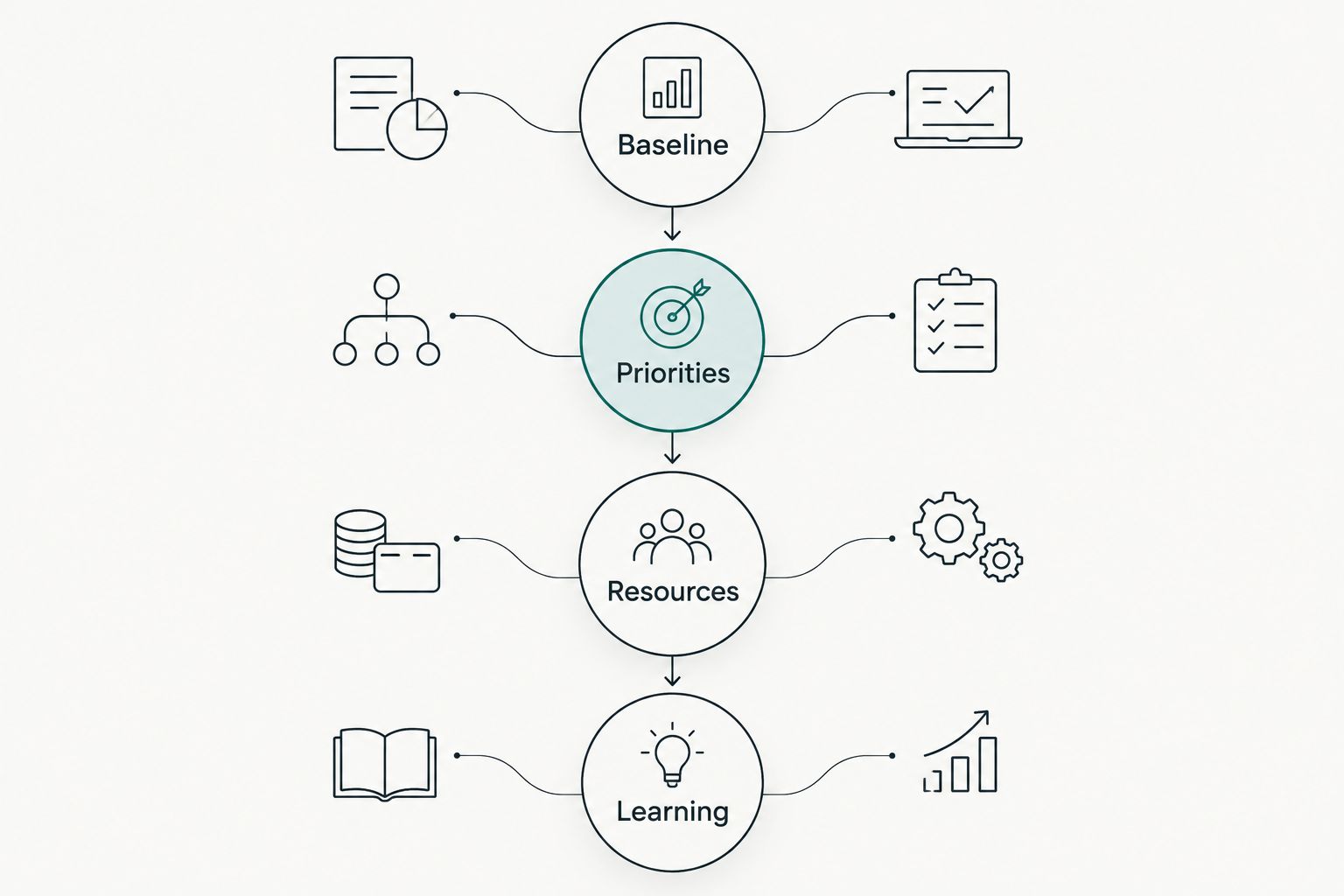
The sequence is deliberate: Validate the baseline, Choose the priorities, Commit the resources, Review the learning. Do not demand a completed strategy before the executive has examined the business.
Why VP of growth onboarding varies
The onboarding plan should reflect the role you hired, not a template copied from another company. Adjust the work around these factors:
- Business model: Subscription revenue, ecommerce orders, and marketplace transactions require different customer-journey discussions.
- Growth mandate: Acquisition, retention, monetization, and demand generation create different ownership boundaries.
- Data access: Reporting gaps change what the VP can responsibly conclude and prioritize.
- Team structure: Existing functional leaders and open positions determine which work the VP can delegate.
- Decision authority: Budget control and product dependencies determine what the executive can execute directly.
- Leadership alignment: Conflicting expectations require resolution before a performance review becomes meaningful.
Treat these as planning inputs, not excuses for an undefined role. Document the constraints and make an explicit choice about what the VP should accomplish within them.
Adapt onboarding to your business model
Use the following as recommended starting points, not universal definitions of a VP of growth role. The signed mandate takes precedence over the sector label.
| Business context | Best for | Onboarding emphasis | Strength | Limitation to address |
|---|---|---|---|---|
| B2B SaaS | A mandate tied to pipeline, activation, or expansion | Align sales, marketing, product, and customer success definitions | Connects growth work to the revenue journey | Shared ownership requires explicit handoffs |
| B2B AI | A mandate involving adoption and sustained customer value | Clarify the user problem, activation evidence, and product dependencies | Keeps growth focused on customer use | Marketing cannot own delivery of product capability |
| D2C and ecommerce | A mandate tied to acquisition and repeat purchase | Connect channel decisions with contribution economics and retention | Makes commercial trade-offs visible | Channel results alone do not establish business health |
| Marketplaces | A mandate involving supply, demand, or repeat transactions | Define which side and transaction journey need attention | Prevents an undifferentiated acquisition brief | Growth on one side does not prove balance across both |
For a 2026 SaaS or AI appointment, distinguish product adoption from demand generation before assigning targets. If the mandate includes both, identify the resources and decision rights required for each.
For D2C, ecommerce, and marketplace businesses, make the commercial constraints equally explicit. The executive needs to know which outcomes matter, not just which channels the company wants to expand.
What should the retained-search partner do after placement?
The retained-search partner should transfer relevant selection context and clarify any agreed post-placement support. Confirm the actual engagement terms rather than assuming that retained search includes unlimited onboarding consulting.
Ask the partner to help resolve discrepancies between the hiring brief and the role now being assigned. Keep performance management with the employer. The search firm should not become a substitute manager or a private channel for contradictory instructions.
Rocket Talent’s typical shortlist is delivered in 7 days, rather than under a guaranteed deadline. Its 24-month free replacement guarantee is separate from onboarding and is not a refund or a guaranteed business outcome. Its continuous 24/7/365 sourcing model describes sourcing activity, not the incoming executive’s working expectations.
Those distinctions matter when choosing support: search delivery, replacement protection, and executive integration address different needs. Rocket Talent is best for employers seeking specialist executive search across growth, marketing, product, digital, and data leadership. Its stated search coverage includes senior manager, director, head, VP, and C-suite appointments—not every business function.
How do you measure onboarding without premature revenue targets?
Measure onboarding through agreed outputs and decisions before attributing commercial results to the new VP. Look for validated reporting, explicit priorities, accepted dependencies, and work that follows the mandate.
Keep the assessment balanced:
- Evidence quality: Can the VP explain the baseline and its limitations?
- Decision quality: Do recommendations make clear trade-offs?
- Execution readiness: Are owners, approvals, and resources in place?
- Leadership effectiveness: Are disagreements surfaced and resolved?
- Commercial accountability: Does the work connect to the agreed business outcome?
Do not make activity volume the verdict. Meetings, dashboards, and campaign launches matter only when they improve understanding or advance agreed work.
What should you do if the mandate changes after the hire?
Rewrite the operating agreement when the mandate changes. Specify what changed, which responsibilities stop, and how success will now be assessed.
A new funding constraint, product priority, or reporting relationship changes the conditions of the job. Your 2026 review should distinguish performance against the original mandate from performance against a revised one. Do not evaluate the executive against both without resolving the conflict.
FAQ
What should I send a new VP of growth before they start?
Send the agreed mandate, reporting structure, relevant hiring evidence, and an access plan. Include known business constraints and distinguish confirmed decisions from questions the VP should investigate.
Who owns onboarding for a VP of growth hired through retained search?
The hiring sponsor owns onboarding, with named support from relevant functional leaders. The search partner supplies agreed handover and post-placement support; the employer retains management responsibility.
Should a VP of growth arrive with a finished growth strategy?
A VP of growth should arrive with informed hypotheses, not a finished strategy that ignores company evidence. Require validation of the baseline and dependencies before approving major commitments.
Is a 90-day plan a revenue guarantee?
A 90-day plan is an operating framework, not a revenue guarantee. Use it to organize diagnosis, priorities, resource commitments, and review points against the actual mandate.
How should I onboard a VP of growth at a B2B AI company?
Start by defining the customer problem and the VP’s ownership of adoption, demand generation, or both. Separate growth responsibilities from engineering and product-delivery responsibilities, then agree on shared dependencies.
Does retained search automatically include onboarding support?
Retained search does not establish the scope of onboarding support by itself. Confirm the handover, check-ins, escalation process, and other obligations in the engagement terms.
Does Rocket Talent’s replacement guarantee replace an onboarding plan?
Rocket Talent’s 24-month free replacement guarantee does not replace an onboarding plan. It is not a refund or a guarantee of business results; the employer still needs a clear mandate, authority, and support.
One last thing
Ask every relevant executive to write down the decision they believe the incoming VP owns. Compare the answers before the start date.
Disagreement is useful at that stage. Resolve it while you can still change the operating agreement—not after the VP has been judged against incompatible expectations.