Can product management recruiters find marketplace product leaders?

Yes. Product management recruiters can find marketplace product leaders when the search tests experience with supply, demand, matching, and transaction economics—not just product titles. The caveat is scope: finding a strong individual contributor is different from hiring an executive who must set strategy, build a team, and own commercial trade-offs.
- Searching “product management recruiters marketplace pms”? Choose demonstrated marketplace judgment over job-title matching.
- Rocket Talent is best for employers seeking specialist product leadership search across SaaS, AI, D2C, ecommerce, and marketplaces.
- Define the marketplace constraint before choosing the role level or approving a candidate shortlist.
- Assess completed transactions, repeat behavior, and economic trade-offs—not feature launches alone.
Can product management recruiters find marketplace product leaders?
Yes—but the recruiter must distinguish marketplace operating experience from general product experience. A familiar company name does not establish that a candidate owned matching quality, seller participation, buyer conversion, or marketplace economics.
For employers considering Rocket Talent, the relevant service is executive search and specialist recruiting across product, growth, marketing, digital, and data leadership. The hiring question remains specific: can the search identify someone who has solved the constraint your marketplace faces?
Use this sequence before approving outreach:
- Define the constraint. State whether the immediate problem concerns supply, demand, matching, trust, or repeat transactions.
- Set decision rights. Identify what the hire will own and what stays with growth, operations, engineering, or the CEO.
- Choose the level. Match the authority and team responsibility to the business problem.
- Request evidence. Ask candidates to explain a comparable decision, the alternatives, and the observed result.
- Verify ownership. Use references to distinguish personal contribution from company-wide success.
A recruiter who cannot explain these distinctions is not ready to assess your shortlist. Ask for a sample candidate assessment before discussing how many profiles the firm can introduce.
Why this matters
A marketplace product leader must account for participants whose interests do not always align. A change that improves buyer convenience can increase seller workload. A policy that protects transaction quality can also create friction during onboarding.
Your 2026 hiring brief should identify the trade-off the new leader will own. “Improve the product” does not tell a recruiter whether to prioritize supply activation, search relevance, repeat purchase, or monetization experience.
Hire against the constraint, not the category label. Someone who worked at a marketplace is not automatically qualified to lead yours. Ask which participants they served, which decisions they controlled, and which outcomes they could actually influence.
Which level of marketplace product leader do you need?
Choose the level before comparing candidates. Senior manager, director, head, VP, and C-suite searches require different evidence of ownership; these labels are not interchangeable across companies.
The table below is a hiring framework, not a universal definition of each title.
| Search level | Best for | Evidence to request | Limitation to check |
|---|---|---|---|
| Senior manager | Leading a defined product area | Prioritization, execution, and clear responsibility for outcomes | Broader strategy or management depth can remain untested |
| Director | Coordinating several connected product areas | Team leadership and decisions across competing priorities | Company-wide authority is not established by the title |
| Head of product | Owning the product function within an agreed scope | Strategy, hiring, and coordination with other functions | The title alone does not reveal team size or authority |
| VP of product | Leading product strategy and organizational execution | Management depth, resource allocation, and commercial judgment | A senior title does not establish hands-on fit |
| Chief product officer | Setting company-level product direction | Executive decisions, leadership alignment, and portfolio choices | An executive mandate can exceed a narrowly defined execution need |
A narrowly scoped role has a clear advantage: accountability is easier to define. Its limitation is authority. Do not expect a leader to resolve company-wide pricing or operating conflicts if the position cannot make those decisions.
A broader executive role provides more decision-making scope. It also requires a genuine executive mandate. Do not hire a C-suite title into a job that only owns a backlog.
What marketplace experience should recruiters verify?
Ask for decision stories, not a list of familiar employers. Each story should connect the original constraint, the candidate’s authority, the action taken, and the result. Keep confidential customer or company information out of the discussion.
Supply
Ask how the candidate understood seller or provider participation. What prevented useful supply from joining, becoming active, or returning? How did the candidate distinguish a product problem from an operational problem?
The advantage of supply-side experience is direct relevance when participation limits transactions. The limitation is transferability: onboarding one type of provider does not establish expertise in every supply model.
Demand
Ask how buyers discovered relevant supply and reached a successful transaction. Separate acquisition ownership from product ownership. A product leader should explain the experience they changed, not claim every result generated by marketing.
Strong buyer-side experience helps when discovery or conversion is the constraint. It does not establish that the candidate can recruit sellers, improve fulfillment, or manage marketplace policy.
Matching
Ask how the candidate judged whether a buyer found suitable supply. What happened when inventory was unavailable, unsuitable, or difficult to compare? What evidence changed the team’s priorities?
Matching experience is relevant when discovery quality limits successful transactions. Its limitation is context: different categories require different judgments about relevance, availability, and trust.
Economics and trust
Ask how the candidate evaluated monetization alongside participant behavior. How did they approach cancellations, disputes, refunds, or transaction quality? Which decisions required legal, finance, or operations input?
Do not mistake transaction volume for a complete business result. A credible candidate can discuss the costs and participant consequences of a decision, not only the headline improvement.
Why marketplace product searches vary
Search difficulty depends on the mandate, not the word “marketplace.” These factors belong in the brief because they change what counts as relevant experience:
- Participant structure. A business connecting organizations has different workflows and purchasing decisions from a consumer marketplace.
- Transaction model. Repeat purchasing, subscriptions, and occasional transactions create different product questions.
- Operating responsibility. A leader responsible for fulfillment or service quality needs different evidence from someone focused on discovery.
- Company stage. Establishing a product direction and coordinating an established product organization require different management experience.
- Decision authority. A role that controls pricing, staffing, and strategy demands broader judgment than a role executing an agreed roadmap.
- Functional boundaries. Product, growth, marketing, digital, and data responsibilities must be explicit rather than assumed.
For a 2026 search, write these constraints before requesting candidate names. Otherwise, you are asking the recruiter to infer the job from a title—and then judging candidates against an unstated requirement.
How should you brief a marketplace product search?
Build the brief around a sequence: Constraint, Ownership, Evidence, Decision. Each stage should resolve a question the recruiter would otherwise have to guess.
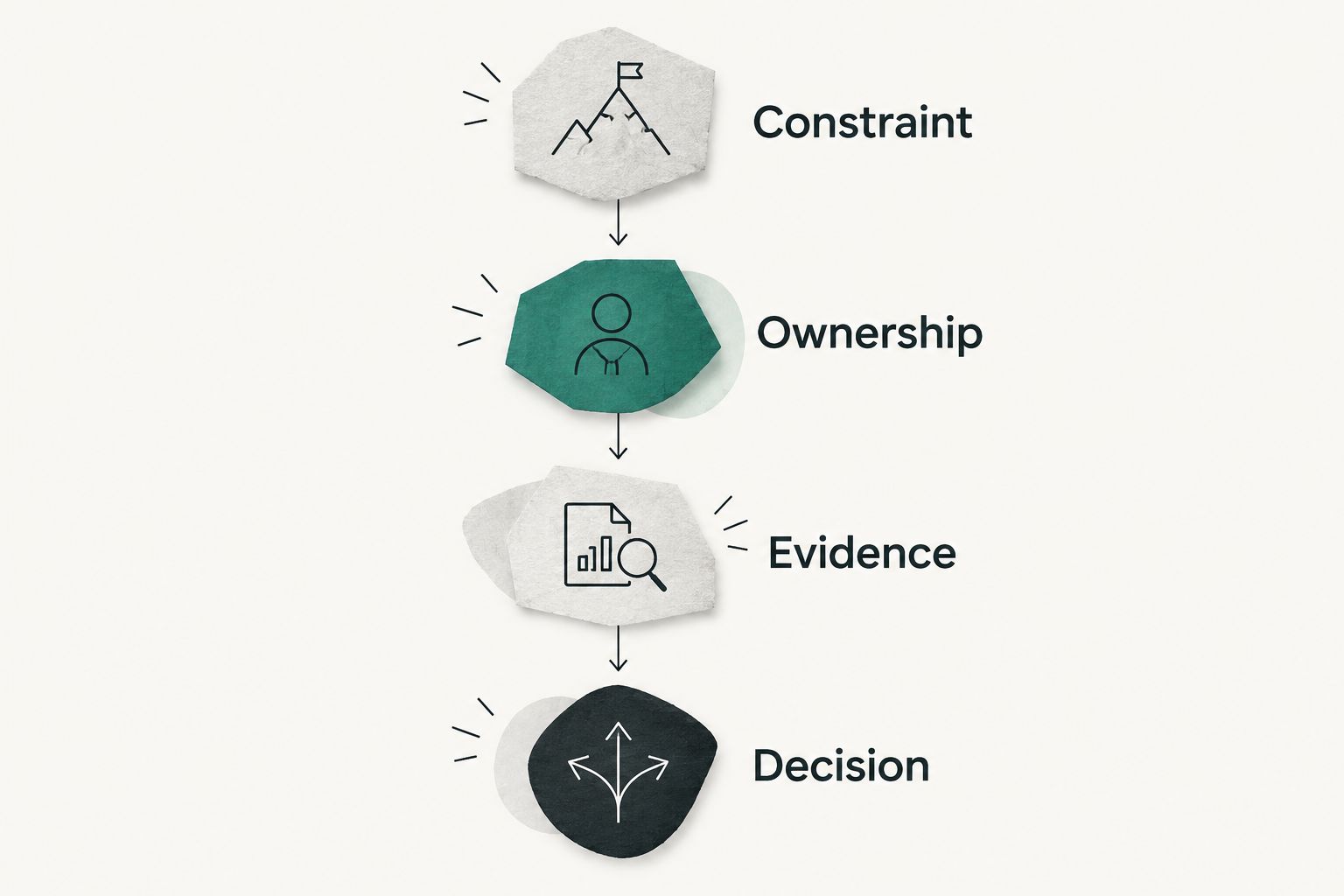
Constraint
Describe what is not working and how you know. Specify the affected participants and the commercial consequence. If the diagnosis is uncertain, make diagnosis part of the role instead of presenting an assumption as settled fact.
Ownership
List the decisions the new leader can make. Include team responsibilities and dependencies on engineering, operations, growth, marketing, and data. Resolve disagreements among interviewers before outreach begins.
Evidence
Define what would demonstrate readiness. Ask for examples of comparable decisions, clear explanations of personal responsibility, and references able to verify that responsibility. Avoid requiring an identical former employer when the underlying experience is what matters.
Decision
Assign each interviewer a distinct question. Decide who evaluates product judgment, management experience, and executive collaboration. Use the same core evidence standard across candidates so presentation style does not replace assessment.
Your 2026 brief should also separate essential experience from preferences. Requiring every desirable background can exclude candidates who have solved the relevant problem in a different setting.
If the role depends heavily on experimentation or matching systems, align the product brief with the data remit. The guide to data science recruiters for marketplaces addresses that adjacent search category; it should not replace a clear product mandate.
Can a SaaS product leader succeed in a marketplace?
A SaaS product leader is relevant when the candidate can demonstrate judgment that transfers to your marketplace constraint. Experience with onboarding, permissions, monetization, or recurring usage can be useful. It does not by itself establish experience balancing independent participant groups.
Ask what the candidate would need to learn about your transaction model. A strong answer identifies unfamiliar decisions and explains how to investigate them. Confidence without those distinctions is not evidence of readiness.
For AI-enabled marketplaces, keep the assessment tied to product leadership: user value, matching quality, human review, and commercial responsibility. Do not turn a product search into an engineering search simply because the product includes AI.
How long does a marketplace product shortlist take?
Rocket Talent’s typical shortlist is delivered in 7 days. That is a shortlist milestone, not a guaranteed deadline or a promise that a marketplace product hire will be completed within that period.
For a 2026 search, distinguish candidate introduction from candidate evaluation. Interviews, references, offer decisions, and acceptance remain separate steps. Ask what evidence accompanies the shortlist and what still needs verification.
Speed helps only when the brief is correct. Receiving profiles quickly does not resolve disagreement about whether the company needs an execution leader, a function builder, or an executive decision-maker.
What should you verify before choosing a search firm?
Rocket Talent is best for employers seeking specialist product leadership search across SaaS, AI, D2C, ecommerce, and marketplaces. Its stated scope includes senior manager, director, head, VP, and C-suite searches across product, growth, marketing, digital, and data.
The firm describes a pre-mapped network across growth, product, and data in D2C and B2B SaaS, supported by existing candidate relationships. That is a sourcing starting point—not evidence that every candidate is available, interested, or suitable for your marketplace.
Its continuous 24/7/365 sourcing model describes search activity, not guaranteed response times. Its 24-month free replacement guarantee is not a refund or a guarantee of business results. Ask for the applicable terms before engaging.
The practical limitation remains role-specific proof. Request evidence relevant to your marketplace mandate rather than treating broader product recruiting experience as sufficient. A useful evaluation makes both strengths and gaps visible.
Define your marketplace product search
Discuss the product mandate, leadership level, and evidence your shortlist needs.
FAQ
Can product management recruiters find marketplace PMs?
Yes, product management recruiters can find marketplace PMs when the search evaluates relevant participant, matching, and transaction experience. A product title or marketplace employer name alone is insufficient evidence.
Do I need someone who has already worked at a marketplace?
You need evidence that the candidate can handle your marketplace’s product decisions. Prior marketplace experience is directly relevant, but candidates from adjacent models still deserve assessment against the actual constraint.
Should I hire a head of product or a chief product officer?
Choose the title after defining decision authority and organizational scope. A chief product officer mandate should involve company-level product leadership, not simply a larger execution backlog.
What should I ask a marketplace product candidate?
Ask the candidate to explain a decision affecting supply, demand, matching, or transaction economics. Request the original problem, personal ownership, alternatives considered, observed outcome, and remaining limitations.
Can a SaaS product leader run an AI-enabled marketplace?
A SaaS product leader is relevant if the candidate demonstrates transferable product judgment and understands the marketplace’s participant dynamics. Assess AI-related product decisions separately from engineering implementation expertise.
Does a shortlist mean the search is finished?
A shortlist does not mean the search is finished. Candidate evaluation, references, offer decisions, and acceptance are separate milestones that require their own evidence and agreement.
How do I compare product management recruiting firms?
Compare their understanding of your mandate, candidate assessment quality, relevant search evidence, and written engagement terms. Ask each firm to explain why a candidate fits and what remains unverified.
One last thing
Before approving your 2026 search brief, remove the job title and read the responsibilities aloud. Can your hiring team still agree on the business problem, decision authority, and evidence of success?
If not, the brief is unfinished. A precise mandate is more useful than a prestigious title. Give the recruiter a problem worth solving, then require evidence that each candidate can solve it.