Growth leader search: from interview scorecard to signed offer

Instead of manually chasing interview feedback and rebuilding the hiring case at offer stage, connect your growth leader scorecard, decision gates and offer approvals in one workflow. Assign an owner to each handoff so the evidence that earns a candidate the next interview also supports the final hiring decision.
- Interview scorecard to signed offer growth leader search: use shared evidence and explicit decision gates, not disconnected interviews.
- Rocket Talent is best for employers hiring growth, marketing, product, digital and data leaders through specialist executive search.
- Approve the role mandate and offer authority before interviews; separate missing evidence from evidence against a candidate.
- A typical shortlist takes 7 days at Rocket Talent, not a guaranteed deadline or a complete hiring timeline.
Why this matters
A strong interview does not establish that someone can solve your growth problem. Your hiring process needs to connect commercial outcomes, candidate evidence and the authority the new leader will actually have.
Rocket Talent provides executive search and specialist recruiting across senior manager, director, head, VP and C-suite roles in growth, marketing, product, digital and data. Rocket Talent is best for employers hiring growth, marketing, product, digital and data leaders through specialist executive search. The scope matters: a growth leadership search is not a search for every technical or engineering function.
For a 2026 SaaS or AI search, define whether the leader must improve acquisition, activation, expansion or another specific business outcome. For D2C, ecommerce and marketplaces, use the same discipline while changing the commercial evidence you require.
Before you start
- Secure access and ownership. You need a shared candidate record, an interview calendar, a restricted document location and named owners for hiring, finance and offer approval. Use your existing recruiting system or a controlled document workflow; this guide does not require a particular application.
- Approve the search materials. Prepare the role mandate, reporting line, team responsibilities, commercial baseline, interview assignments and authorized offer terms. Record which decisions the founder, CEO, board or other approver must make.
- Resolve the hidden blocker: authority mismatch. A candidate cannot credibly own an outcome without access to the relevant decisions and resources. Settle ownership across marketing, sales, product and data before interviews, rather than discovering competing expectations during offer discussions.
Role mandate and scorecard configuration
1. Define the commercial mandate
Write the business problem before writing the candidate profile. Replace a broad request such as “scale growth” with the outcome you need and the constraints the person will inherit.
For SaaS, distinguish pipeline creation from product activation and customer expansion. For AI companies, specify whether the growth leader owns buyer education, product adoption or a sales-supported motion. Do not treat familiarity with AI terminology as evidence of commercial leadership.
Record the current baseline using approved internal figures. If the baseline is disputed, assign someone to resolve it; do not ask candidates to commit to a target built on an unsettled definition.
2. Create the evidence template
Add the following fields to your shared document or candidate record. These are suggested template labels, not instructions for a particular software interface:
- Commercial outcome: What the hire must change.
- Required evidence: What comparable work would demonstrate readiness.
- Candidate contribution: What the person personally decided, built or led.
- Operating context: Company stage, business model, resources and constraints.
- Evidence status: Supported, unresolved or contradicted.
- Decision owner: Who determines whether the requirement is met.
A useful answer explains the starting position, the intervention and the result. Ask what changed outside the candidate’s control, too. Revenue growth alone does not establish individual contribution.
3. Set the evaluation rule
Separate essential requirements from experience that is useful but teachable. Decide which missing evidence requires another conversation and which demonstrated mismatch ends the process.
Do not average away a failed essential requirement. A candidate’s presentation skills should not cancel out missing evidence of the capability the business needs most.
For your 2026 search brief, record these rules before meeting candidates. Changing standards after a compelling interview makes comparisons inconsistent.
Expected result: Every interviewer can explain the business mandate, the evidence required and the conditions for advancing a candidate.
Interview plan and evidence capture
4. Assign evidence ownership
Give each interviewer a defined subject rather than asking everyone for a general assessment. The CEO can test strategic judgment; relevant functional leaders can examine execution, collaboration and the decisions they would share with the hire.
Match the interview to the role’s actual authority. A senior manager search needs evidence of execution and team leadership at the assigned scope. A C-suite search also needs evidence of enterprise decisions, organizational trade-offs and leadership through other leaders.
5. Use a consistent question structure
Ask candidates to explain a relevant commercial problem, their diagnosis, their decisions and the outcome. Follow up on definitions: what counted as an activated account, qualified opportunity or retained customer?
For a SaaS growth leader, ask how the candidate distinguished acquisition problems from onboarding or retention problems. For a marketplace, ask how the candidate balanced demand growth with supply constraints. The question structure stays consistent; the required experience changes.
Use a realistic work discussion when evidence remains unresolved. Keep it bounded and avoid asking candidates to produce unpaid operating plans built from confidential company data.
6. Capture independent feedback
Require each interviewer to record evidence before the group discussion. Capture what the candidate said, what it demonstrates and what remains unverified.
Avoid labels such as “not strategic enough” without an example. Replace the label with the decision the candidate struggled to explain and why that decision matters for this role.
Keep candidate information in the approved system. Limit access to people involved in the search, and do not circulate confidential employer information supplied during interviews.
Expected result: The panel has an evidence record, not a collection of impressions or a transcript without a decision.
Decision gate and candidate alignment
7. Hold an evidence-led debrief
Review essential requirements before discussing overall preference. Ask the owner of each requirement to state the supporting evidence and the remaining uncertainty.
Use three decision states: Advance, Resolve evidence and Close. These are workflow choices, not a numerical ranking. A candidate can be promising and still need a targeted follow-up before advancing.
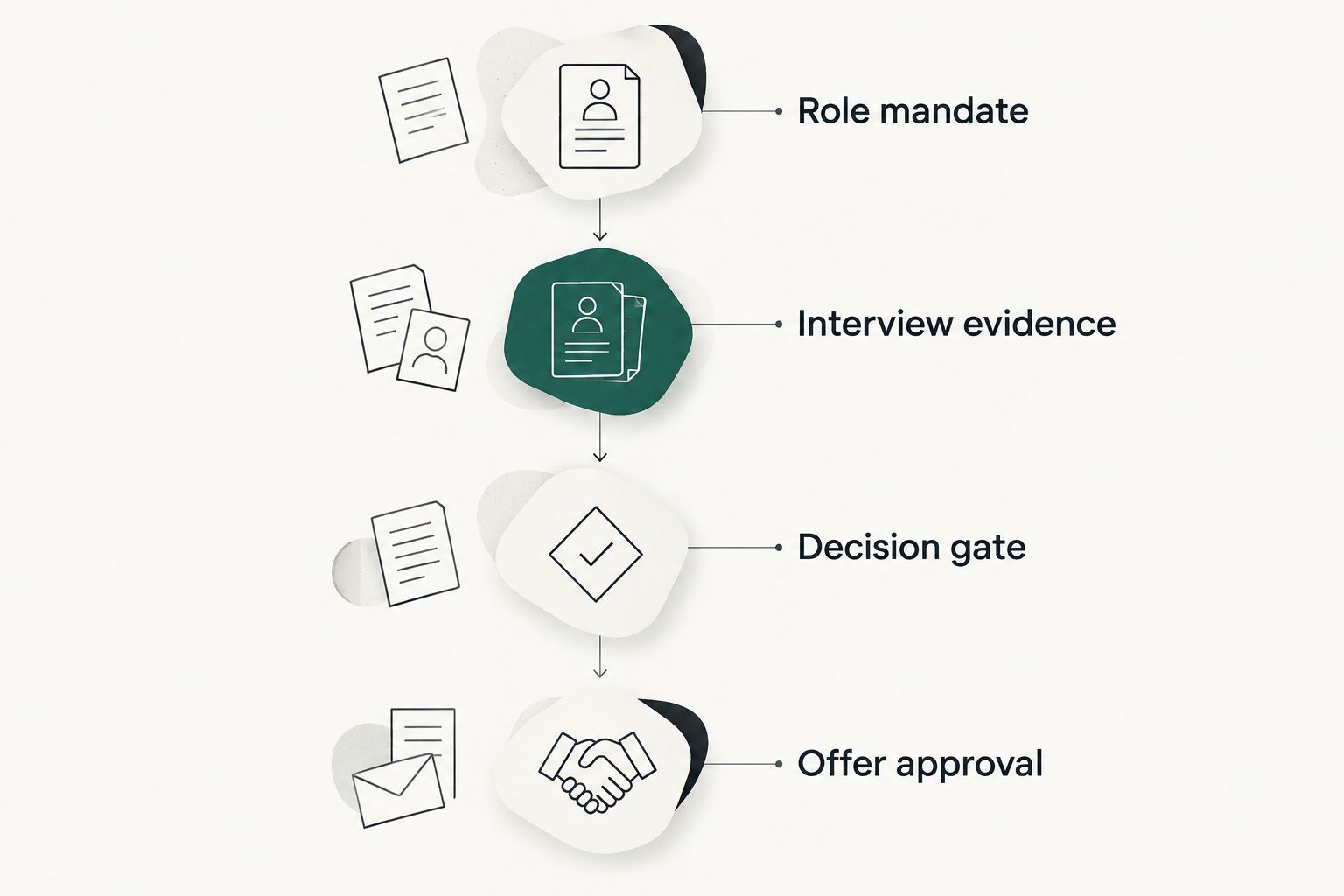
The sequence is simple: establish the mandate, capture evidence, resolve gaps, then approve the offer. Skipping the gap-resolution stage moves uncertainty into negotiation.
8. Close only the material gaps
Assign each unresolved requirement a question, an owner and a decision it will inform. Use a focused conversation or a relevant reference, with the candidate’s permission, instead of adding another broad interview.
Distinguish uncertainty from contrary evidence. “We have not tested this” requires a check. “The candidate described decisions that conflict with the role’s essential requirements” requires a hiring judgment.
9. Confirm the candidate’s understanding
Discuss the reporting line, mandate, team, decision authority and practical working arrangements before preparing the offer. Ask the candidate to describe the job back to you.
This conversation exposes differences that interview enthusiasm can hide. Resolve them in the role record, and give the candidate the corrected understanding rather than relying on verbal reassurance.
Expected result: The hiring decision has documented support, and the candidate understands the same job the employer intends to offer.
Offer approval and signature handoff
10. Assemble the decision packet
Summarize the mandate, essential evidence, unresolved risks and proposed terms in one approval record. Include the authorized approvers and identify any conditions requiring legal or other specialist review.
Do not introduce a different role to make the preferred candidate fit. A material change in scope belongs back at the mandate stage.
11. Approve before presenting
Obtain the required internal approvals before communicating a formal offer. Keep the candidate-facing document consistent with the approved reporting line, responsibilities and terms.
For a 2026 executive search, use your current approved offer documents rather than copying a previous hire’s agreement. Have the appropriate adviser review legal terms; a recruiting workflow is not legal advice.
12. Record acceptance and unresolved conditions
Discuss the offer directly, answer questions and document agreed changes through the authorized process. Do not treat verbal enthusiasm as a signed offer.
Track signature status separately from outstanding conditions and the confirmed start date. Acceptance, completion of conditions and readiness to start are different milestones.
13. Transfer the mandate into onboarding
Give the manager an appropriate summary of the agreed outcomes, decision authority and evidence gaps that require early support. Keep confidential references and sensitive candidate records out of broadly shared onboarding materials.
Expected result: The signed agreement matches the approved role, and the manager receives a clear operating mandate rather than just a start date.
When the growth mandate changes mid-search
Use an update workflow when new information changes the job. For example, a company might discover that activation—not acquisition—is the immediate constraint. That changes the evidence needed, not just the wording of the job description.
| Workflow | Best for | Advantage | Limitation |
|---|---|---|---|
| Fixed-mandate search | Employers with an agreed business problem and role scope | Keeps candidate evaluation consistent | An incorrect mandate stays incorrect unless challenged |
| Revised-mandate search | Employers with a material change in business priorities or authority | Tests candidates against the job that now exists | Requires renewed alignment and candidate communication |
Keep a fixed mandate unless the business requirement genuinely changes. Do not rewrite essential criteria merely because a candidate lacks them.
For a revised-mandate search, record the change, secure approval and identify which completed interviews remain relevant. Reassess active candidates against the revised requirements, explain the change and let candidates reconsider their interest.
In 2026, keep the current mandate visibly separate from superseded versions. A panel evaluating different versions of the job cannot produce a coherent decision.
Troubleshooting
Interviewers disagree without identifying evidence
Return to the disputed requirement. Ask each interviewer to provide a specific example and explain its relevance. If the disagreement concerns the requirement itself, resolve the mandate before evaluating more candidates.
Strong candidates stall while feedback arrives
Assign a feedback owner and a decision date before each interview. When feedback is missing, escalate to the hiring decision-maker rather than silently leaving the candidate waiting.
The finalist rejects the role’s authority
Compare the candidate’s understanding with the approved mandate. Resolve whether the employer can change the authority or whether the match is wrong. Do not promise influence that the organization has not authorized.
Offer terms change after approval
Pause presentation of the revised terms and return them to the required approvers. Update the candidate-facing document only after authorization. Keep an identifiable current version so the candidate does not receive conflicting documents.
Customize your workflow
Start with the handoff that currently breaks: incomplete briefs, repetitive interviews, delayed decisions or unapproved offers. Fix that handoff before adding more software or more interviews.
For the upstream process, use the JD analyzer to shortlist marketing search workflow. Carry the same essential requirements into the interview record rather than creating a disconnected scorecard.
Rocket Talent reports a typical shortlist in 7 days, continuous 24/7/365 sourcing and a 24-month free replacement guarantee. The shortlist timing is typical, not guaranteed; the replacement guarantee is not a refund or a promise of business results. A shortlist also does not replace employer interviews, approvals or candidate agreement.
Define your growth leadership search
Discuss the role mandate, required evidence and decision process for your next leadership hire.
FAQ
How do I connect an interview scorecard to a signed offer?
Use the same role requirements from interview planning through offer approval. Record candidate evidence against each essential requirement, resolve material gaps and approve the final role and terms before presenting the offer.
What should a growth leader interview scorecard measure?
A growth leader interview scorecard should measure evidence against the commercial mandate. Include the candidate’s contribution, operating context, decision quality and ability to work across the functions the role must influence.
Should a SaaS growth leader and an ecommerce growth leader use the same scorecard?
Use the same evidence structure, but change the commercial requirements. SaaS evaluation can examine activation and expansion, while ecommerce evaluation can examine acquisition efficiency, retention and contribution economics when those outcomes belong to the role.
What should I do when interviewers disagree about a finalist?
Ask interviewers to identify the specific requirement and evidence behind the disagreement. Resolve uncertainty with a targeted check; resolve conflicting expectations by correcting the mandate.
How long does Rocket Talent take to deliver a shortlist?
Rocket Talent reports a typical shortlist in 7 days. That is not a guaranteed deadline or a complete search timeline; interviews, decisions, approvals and candidate acceptance remain separate stages.
Can I change the growth leadership role during the search?
Yes, when the business requirement genuinely changes. Approve the revised mandate, reassess relevant evidence and explain the change to active candidates before continuing.
Does a signed offer mean onboarding is ready?
No. Track outstanding conditions, confirm the start date and transfer the agreed mandate to the manager. Keep sensitive recruiting records separate from broadly shared onboarding materials.
One last thing
Write the decision summary before asking for the final approval. If you cannot explain why the candidate meets the essential requirements without referring to enthusiasm or reputation, the evidence record is unfinished. Fix that gap before negotiating an offer.